EN
EN DE
DE ES
ES FR
FR NL
NL PT
PT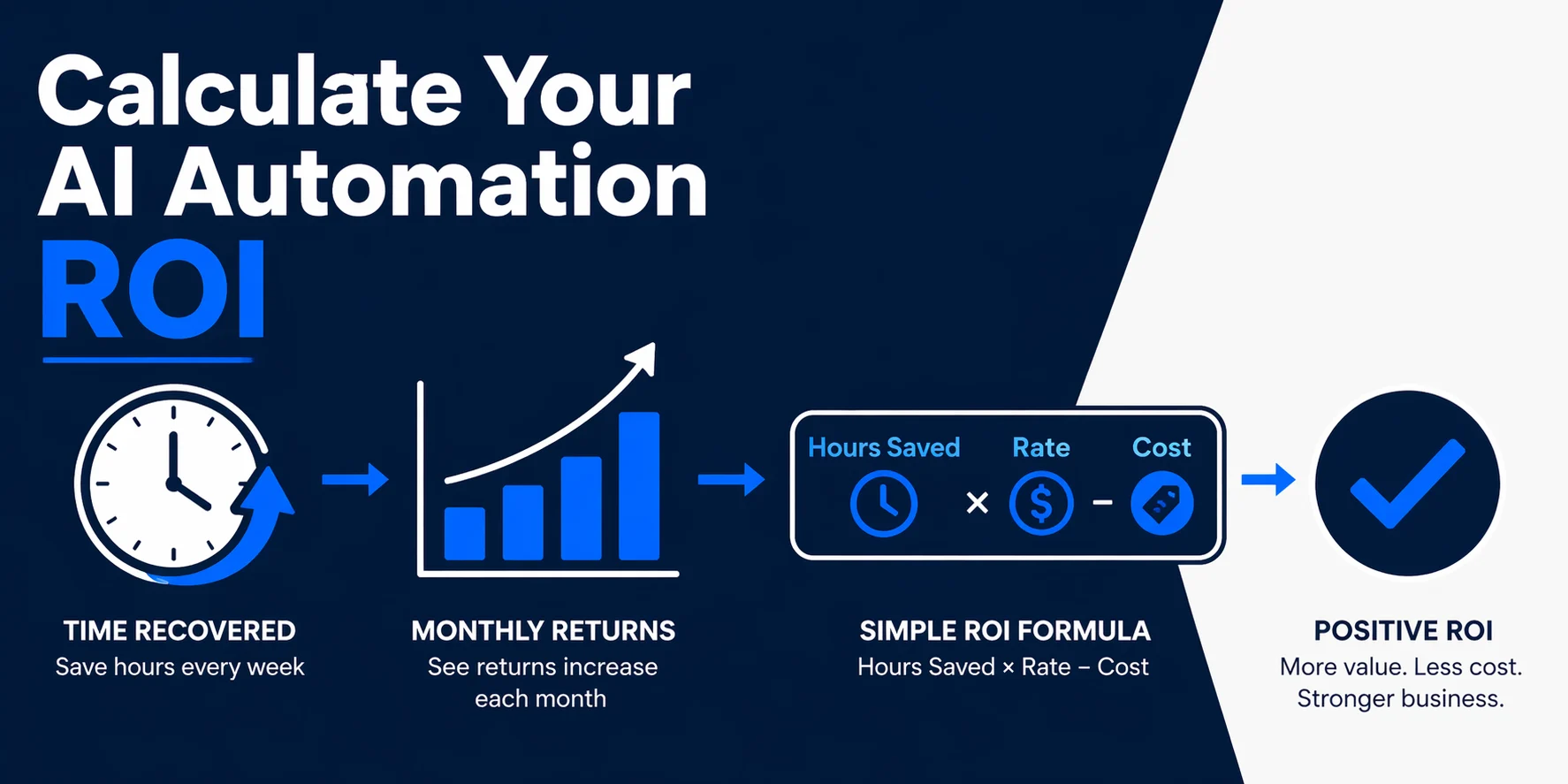
Quick Answer: The ROI of AI automation for small businesses is calculated as: (hours saved per week x 4.3 x your hourly rate) minus monthly tool and implementation costs. Most small businesses reach positive ROI within 3 to 6 months. Businesses recovering 13 hours per person per week see roughly $4,700 per month in productivity value at an average tool cost of around $120 per month.
Most business owners know they spend too much time on manual work. Fewer have actually calculated what that time costs them. The ROI of AI automation for small businesses only becomes obvious once you put a number on the hours going to tasks that should not require a human at all.
This article gives you the formula, the real benchmarks, and a clear framework for working out whether automation is worth the spend for your business specifically.
Most Business Owners Underestimate What Manual Work Costs Them
Manual tasks feel free because no invoice arrives for them. But if you are spending 10 hours per week on CRM updates, follow-up emails, and invoice chasing, and your effective hourly rate is $75, that is $3,250 per month in lost productive capacity. Every month.
That is not a productivity problem. It is a revenue problem.
The issue is that most business owners have never sat down and assigned a dollar value to their admin time. They track what they spend on tools and subscriptions. They rarely track what their own hours are worth when spent on low-value repetitive tasks instead of client work, sales, or growth.
AI automation changes the calculation. Not by replacing judgment or skill, but by taking the work that repeats the same way every time and running it automatically, in the background, while you do something more valuable.
The ROI Formula for AI Automation
The core calculation is straightforward:
(Hours saved per week x 4.3 x your hourly rate) - monthly costs = monthly net ROI
Here is a worked example for a five-person service business:
- Admin hours saved per week: 8 hours across the team
- Owner equivalent hourly rate: $75
- Monthly productivity recovered: 8 x 4.3 x $75 = $2,580
- Monthly tool cost (Make or n8n): $40
- One-time implementation fee: $999 (amortised over 12 months = $83/month)
- Monthly costs total: $123
- Monthly net ROI: $2,457
- Break-even: under 2 weeks
The formula works at any scale. A solo operator saving 5 hours per week at $100 per hour recovers $2,150 per month for a tool cost of $40. A 15-person team saving 2 hours each per week recovers over $12,000 per month in equivalent productivity.
Which Automations Have the Fastest Payback
Not all automations are equal. These four deliver the fastest payback for small service businesses:
1. Lead follow-up automation. Responding to inbound leads within 5 minutes instead of 24 hours directly affects how many deals you close. This automation pays back within days of going live, not months.
2. CRM auto-updates. Eliminating manual CRM entry after every call and meeting saves 1 to 3 hours per day for a typical team. The time savings are immediate and compound across every team member.
3. Invoice and payment follow-up. Automated invoice generation and payment reminders remove one of the most time-consuming admin sequences in any service business. For firms processing 20 to 30 invoices per month, this alone justifies the cost.
4. Email response automation. Handling inbound enquiries with context-aware AI replies removes a significant chunk of inbox time for owner-operated businesses that receive a high volume of similar requests.
For a breakdown of what these look like across different business types, AI use cases for small businesses covers the specific workflows in plain language.
Real Benchmarks: What Small Businesses Actually Recover
The numbers from real implementations are consistent and worth knowing before you run your own calculation.
AI automation saves teams approximately 13 hours per person per week, equivalent to roughly $4,739 per month in productivity gains. That is based on real usage data, not projections.
Small businesses typically see positive ROI within 3 to 6 months of implementing AI automation, with annual returns in the range of 280 to 520% based on aggregated case study data.
84% of businesses investing in AI and automation report gaining positive ROI, according to Deloitte’s 2025 Tech Value Survey of nearly 550 business leaders.
These benchmarks hold across business sizes. The key driver is how many hours are currently going to repeatable manual tasks. If the answer is five or more hours per week, the ROI case is almost always strong.
Want to know your specific automation ROI before spending anything? Automiq AI offers a free discovery call where we map out which workflows will save your team the most hours and calculate your estimated monthly recovery. See pricing and packages to understand the investment.
How to Calculate Your Own Baseline Before You Automate
Before you invest, run this five-step baseline exercise:
- List your top five most repetitive tasks. Think about what you or your team do the same way, multiple times a week, without much variation.
- Time yourself doing each one. Actually clock it. Most business owners underestimate these tasks by 30 to 50%.
- Multiply by weekly frequency. How many times does each task happen per week? Per month?
- Apply your hourly rate. Use your effective rate: what you charge clients, or what you would pay someone to do this work.
- Total the monthly cost. This is your automation target. Any implementation that costs less than three months of this figure has a clear ROI case.
A business owner spending 12 hours per week on tasks that repeat at $80 per hour is absorbing $2,064 per month in tasks that could be automated. That number changes how the conversation about implementation cost feels.
For a deeper look at which processes are worth targeting first, how AI reduces manual work in small businesses breaks down the highest-impact areas.
When AI Automation Does Not Pay Off
Not every automation delivers a strong return. The cases where it does not usually share one of three problems:
The task does not repeat enough. If a process happens twice a month, the time saved rarely justifies the build cost. Automation works best on tasks that happen at least five times per week.
The task requires constant human judgment. Automating a workflow where every case is genuinely different just creates a system that fails regularly. Automation is for consistent, rule-based work.
The automation is built incorrectly the first time. DIY automations that are not architected properly break quietly. You think you are saving time; the system is silently failing. Getting the design right matters as much as getting it built.
Honest ROI analysis includes these failure modes. If your highest-volume tasks are genuinely variable or judgment-heavy, the ROI case is weaker and worth a closer look before committing.
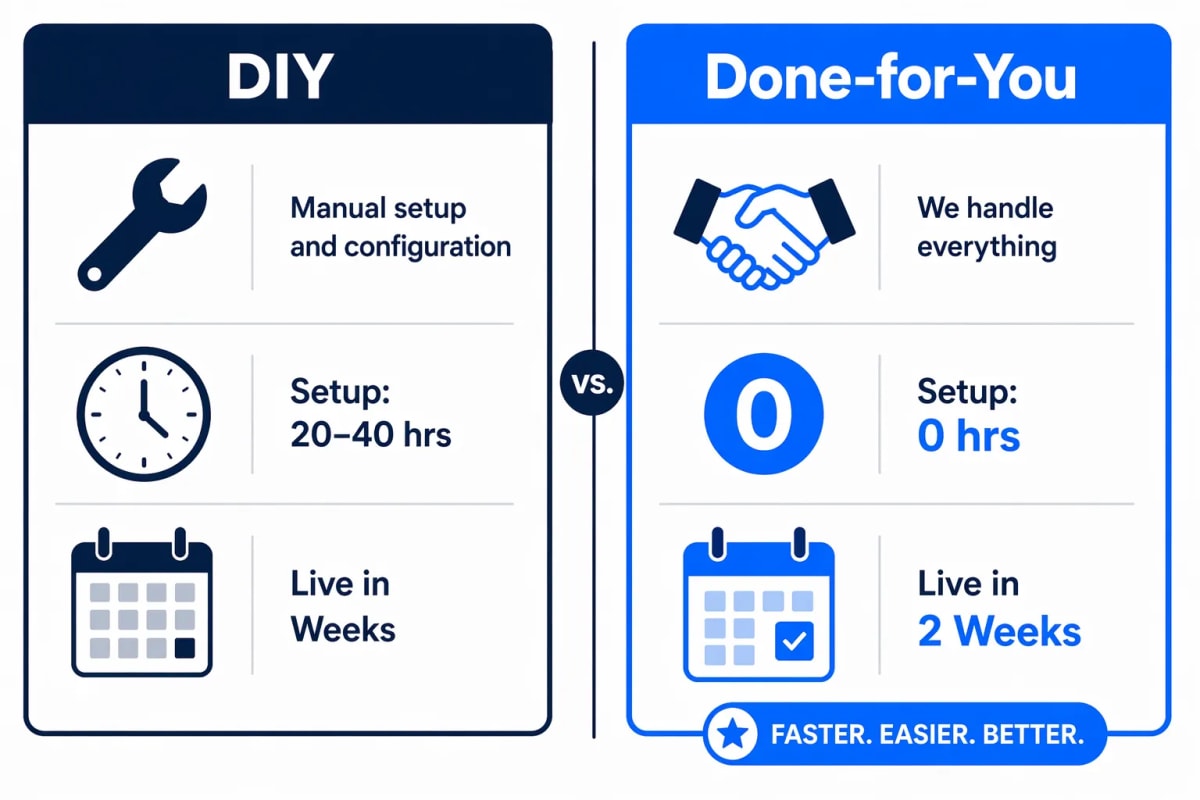
Done-for-You vs. DIY: Which Gets Better ROI?
The sticker price comparison between DIY (free platform tier, you build it) and done-for-you (fixed implementation fee) makes DIY look cheaper. The full 12-month comparison looks different.
| DIY (Make / n8n) | Done-for-You (Automiq AI) | |
|---|---|---|
| Setup time cost (at $75/hr) | 20 to 40 hrs = $1,500 to $3,000 | Zero |
| Tool subscription (monthly) | $20 to $60 | Same (included in your stack) |
| Time to live | Weeks to months | 1 to 2 weeks |
| Time to positive ROI | Slower (setup delays payback) | Faster (live immediately) |
| Maintenance overhead | Ongoing (owner or a hire) | Covered post-launch |
| 12-month total cost (typical) | $2,000 to $4,000 | $700 to $1,700 one-time |
When you assign a real cost to the 20 to 40 hours you spend building and debugging a DIY automation, done-for-you is often cheaper on a 12-month basis, even before you factor in the payback that starts earlier.
The automation solutions by industry page covers what done-for-you implementation looks like for different business types, with the specific workflows that go live first.
Frequently Asked Questions
How long does it take to see positive ROI from AI automation for a small business?
Most small businesses reach positive ROI within 3 to 6 months. For high-frequency workflows like lead follow-up or invoice processing, payback can be as short as 30 days because time savings start immediately and the cost is a one-time fee.
What is a realistic payback period for a $999 automation package?
If the automation saves 5 hours per week at a $75 hourly rate, that is $1,625 per month recovered. At a $999 cost, you break even in under three weeks. The key variable is your hourly rate and how often the automated task repeats.
Does AI automation ROI change for solo operators?
For solo operators, ROI is often higher because every hour of admin you stop doing goes directly back into billable work or business development. The lower the team size, the more directly owner time drives revenue.
Which business processes deliver the highest ROI when automated?
Lead follow-up automation consistently delivers the highest return because it directly affects revenue. CRM updates and invoice processing come second, both saving 1 to 3 hours per day across the team.
Do ongoing tool subscription fees affect my automation ROI calculation?
Yes, include them. Tool costs (Make, n8n) typically run $20 to $60 per month. For most businesses, this represents 1 to 5% of the monthly productivity value recovered, so it rarely changes the ROI case materially.
Is done-for-you automation worth more than DIY when measuring total ROI?
When you factor in 20 to 40 hours of setup time at your own hourly rate, done-for-you often has better 12-month ROI even at a higher upfront price. The break-even comparison shifts once owner time has a real cost assigned to it.
If you can identify five or more hours of repeatable weekly admin, you have a strong ROI case for automation. The question is not whether the return is there. It is which workflows you start with.
Book a free discovery call with Automiq AI and we will calculate your automation ROI baseline, map your highest-value workflows, and show you exactly what goes live first. Book your call