EN
EN DE
DE ES
ES FR
FR NL
NL PT
PT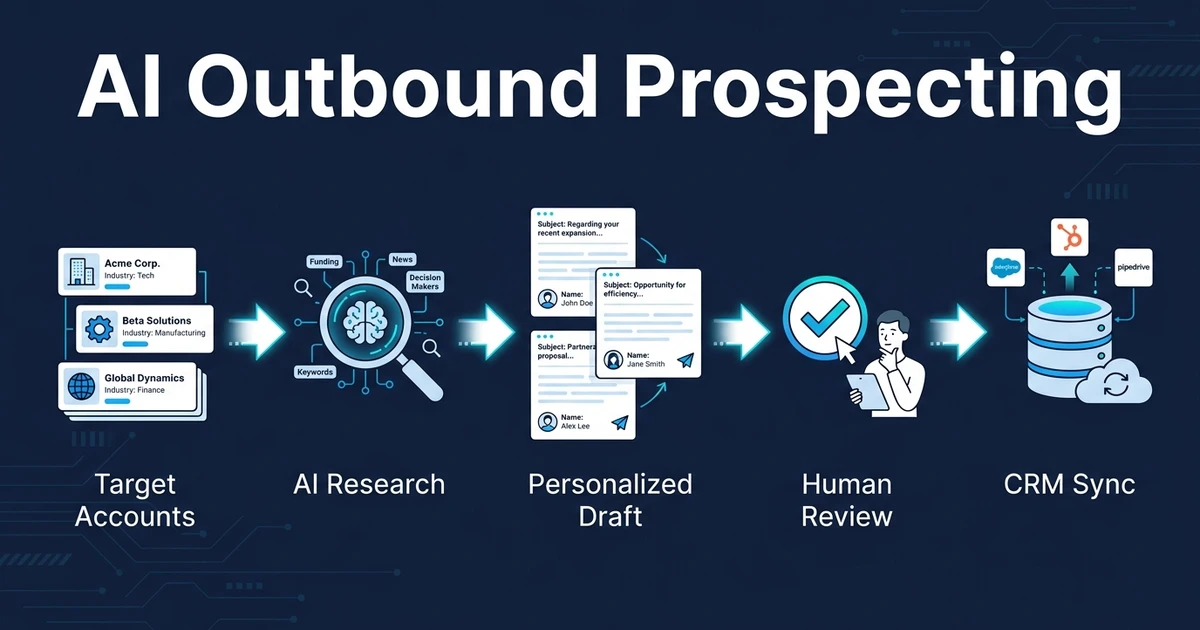
Quick Answer: AI outbound prospecting automation helps your team find better-fit accounts, research prospects, draft personalized outreach, schedule follow-ups, and log activity in your CRM. The best workflows do not replace sales judgment. They remove the research and admin that stop your team from starting enough good conversations.
Outbound prospecting sounds simple until you do it every week.
You need the right accounts, the right contacts, a reason to reach out, a message that does not sound copied, a follow-up plan, and a CRM record your team can trust.
That is a lot of manual work before a single conversation starts. AI-assisted outbound exists to remove that drag without turning your sales motion into spam.
Why Manual Outbound Prospecting Breaks for Small Sales Teams
Manual outbound breaks because prospecting is not one task. It is a chain of small tasks that compete with client work, sales calls, delivery, and admin.
Your team has to define the target account, find contacts, check fit, research context, draft outreach, remember follow-ups, log activity, and spot replies that need attention.
For a founder or small sales team, that chain is hard to sustain. The first few campaigns get energy. Then the spreadsheet gets stale, follow-ups slip, and CRM records fall behind.
Salesforce found that 48 percent of sales reps say they lack bandwidth for adequate cold outreach, even though pipeline requires more contacts and more engagement than teams can deliver manually in its 2026 State of Sales research. That is the real bottleneck: not motivation, but capacity.
What Is AI Outbound Prospecting Automation?
AI outbound prospecting automation is a workflow that helps your team identify target accounts, research prospects, draft outreach, schedule follow-ups, and update CRM activity.
It is not just mass emailing. Mass emailing makes noise. Prospecting automation should improve account fit, message relevance, and sales follow-through.
The workflow starts before the first message. It checks whether an account matches your ideal customer profile, gathers useful context, prepares a draft, and gives your team a clean handoff.
The best version keeps a human in control. AI handles the repetitive research and setup. Your team approves the message, handles judgment calls, and owns the relationship.
What an Automated Prospecting Workflow Should Include
A strong outbound workflow should cover the full prospecting path, not just the send button.
If one step stays manual, that step becomes the bottleneck. If one step runs without review, that step becomes the brand risk.
A practical workflow includes:
- Define the ideal customer profile and exclusion rules.
- Source target accounts from approved lists or CRM segments.
- Enrich account and contact details where allowed.
- Summarize relevant context for each prospect.
- Draft a first-touch message using that context.
- Queue the message for human review.
- Schedule follow-up steps if there is no reply.
- Triage replies into interested, not now, not a fit, or needs review.
- Update CRM records with status, notes, and next action.
That workflow gives your team a controlled system. It does not ask them to choose between slow manual prospecting and reckless automation.
Where AI Helps Most in Prospect Research and Outreach
AI is strongest where the work is repetitive but context-heavy. Prospect research is a perfect example.
A person can spend time moving between websites, CRM records, LinkedIn profiles, old notes, and spreadsheets before they write one useful line. AI can gather and summarize that context faster, then prepare a draft your team can review.
Salesforce reports that 87 percent of sales organizations currently use some form of AI, and sellers expect AI agents to cut prospect research time by 34 percent and email drafting by 36 percent once fully implemented in its 2026 sales survey.
Those gains matter because outbound quality depends on preparation. Better research gives the message a reason to exist. Better drafting gives your team a stronger starting point.
Gartner defines AI in sales as technology that helps sellers work more efficiently, simplify the buyer journey, and improve the overall customer experience in its AI in sales guidance. That is the right frame for outbound. The goal is not to automate human connection away. The goal is to remove the work that keeps your team from starting it.
A Practical AI Prospecting Workflow for a B2B Service Business
Imagine a small professional services firm trying to reach companies that match a specific customer profile. The team knows the target market, but the prospecting work keeps getting pushed behind delivery.
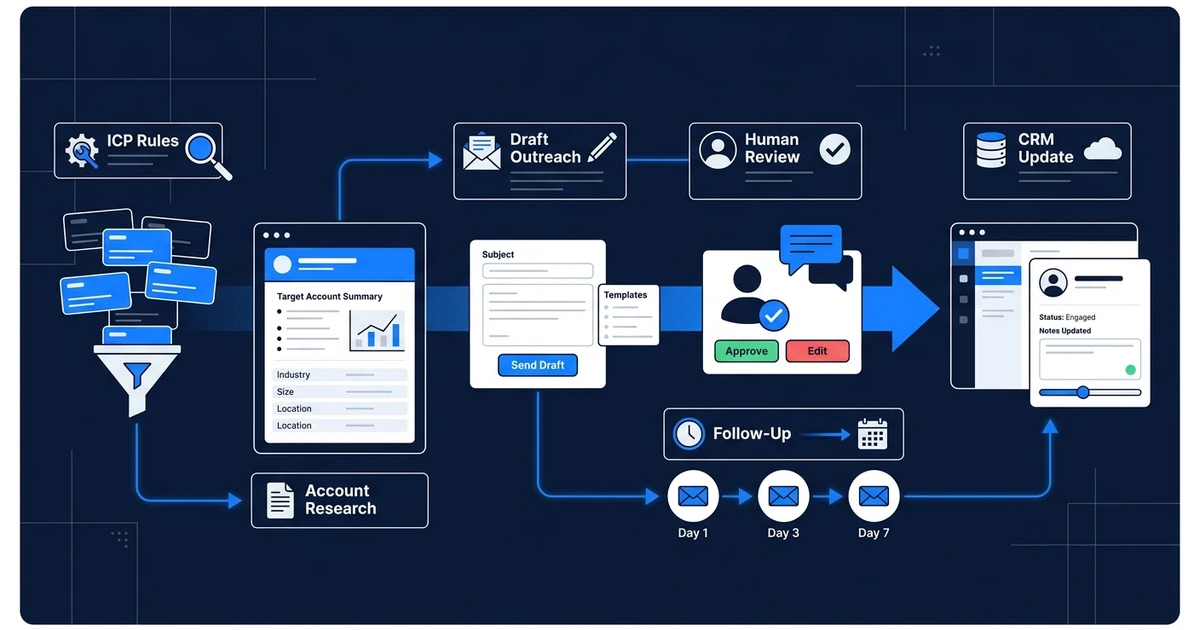
Before automation, the process lives in a spreadsheet. Someone researches accounts, writes notes, drafts emails, copies data into the CRM, and tries to remember who needs a follow-up.
With an AI-assisted workflow, the process becomes more controlled:
- The team defines fit criteria and excluded industries.
- The workflow reviews target accounts against those criteria.
- AI prepares a short research summary for each approved account.
- The system drafts a relevant first message.
- A human reviews and edits before anything sends.
- Follow-up tasks and CRM fields update automatically.
- Replies get categorized for sales action or removal.
The outcome is not “more emails.” It is less manual prep per good account, cleaner CRM records, and a clearer path from prospect research to real conversation.
Automiq AI builds outbound prospecting workflows that research accounts, draft outreach, sync CRM activity, and keep humans in control. Book a discovery call with Automiq AI to map the first workflow around your current sales process.
AI Outbound Prospecting vs Inbound Lead Management
Outbound prospecting and inbound lead management solve different problems.
Outbound starts with target accounts that may not know you yet. The workflow helps you identify fit, build context, draft outreach, follow up, and track replies.
Inbound starts when someone has already raised their hand. The workflow captures, qualifies, routes, responds, and updates the CRM after that signal arrives.
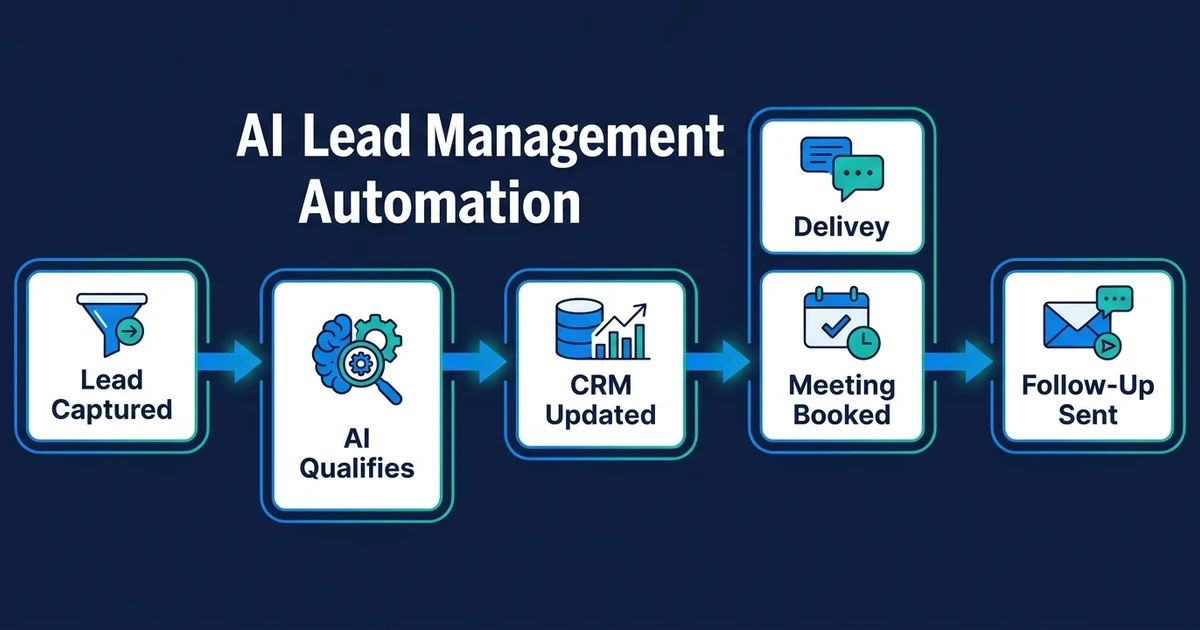
That distinction matters for content, process, and tooling. If your main problem is responding to existing enquiries, start with AI lead management automation. If your problem is creating more qualified conversations from target accounts, outbound prospecting automation is the better fit.
DIY Tools vs Done-for-You Outbound Prospecting Automation
You can build a simple outbound setup yourself. If you have one list, one message, and one follow-up path, a lightweight tool stack may be enough.
The complexity starts when your process needs data checks, account research, custom drafts, human approvals, reply categories, CRM sync, and suppression rules.
| Option | Best fit | Main tradeoff |
|---|---|---|
| Simple DIY sequence | Small campaign with one audience and one message path | Fast to launch, but limited context and weak CRM discipline |
| Internal sales ops build | Team with process ownership and technical capacity | More control, but requires ongoing maintenance |
| Done-for-you workflow | Small team that wants prospecting automation built around existing tools | Needs upfront process clarity, but avoids the learning curve |
McKinsey estimates that generative AI could create 0.8 trillion to 1.2 trillion dollars in productivity across sales and marketing in its B2B sales analysis. But productivity only turns into pipeline when the workflow is built around real sales behavior.
That is why done-for-you AI automation is often the more practical choice for small teams. The value is not owning another tool. The value is having the research, drafting, review, follow-up, and CRM update path working together.
How to Avoid Spammy AI Outreach
Bad outbound automation creates more noise. Good outbound automation creates more relevant conversations.
The difference comes down to guardrails. Your workflow should start with clean targeting, clear exclusion rules, message review, and a real reason for each touch.
Use AI to prepare better context, not to blast generic claims. A prospect should be able to see why you reached out to them specifically.
The workflow should also respect suppression lists, unsubscribe signals, regional rules, and internal do-not-contact criteria. This is not legal advice, but your team needs a process that follows the email and privacy rules that apply to your market.
The important word is productivity. If automation creates low-quality outreach, it is not productivity. It is cleanup work.
AI integration helps keep the workflow connected to your existing CRM, inbox, and sales tools, so prospecting does not become another isolated system your team has to maintain.
Frequently Asked Questions
What is an AI outbound prospecting workflow?
AI outbound prospecting automation is a workflow that helps find target accounts, research prospects, draft personalized outreach, schedule follow-ups, and update your CRM. It removes repetitive research and admin while keeping sales judgment in the process.
Is AI outbound prospecting the same as cold email automation?
No. Cold email automation usually focuses on sending sequences. AI outbound prospecting automation includes the earlier and later steps too, such as account research, list qualification, message drafting, reply triage, and CRM logging.
Can AI prospecting work without a dedicated SDR?
Yes, and that is often where it helps most. A founder or small sales team can use AI to compress research and drafting time while still reviewing messages before they go out.
Should AI send outreach automatically or draft it for review?
For most small B2B teams, AI should draft and prepare outreach for human review before sending. Full automation may work for narrow, low-risk campaigns, but human approval protects quality, relevance, and brand voice.
How does outbound prospecting automation connect to CRM?
The workflow should create or update contact records, log research notes, record outreach status, and trigger follow-up tasks. Your CRM stays the source of truth instead of becoming another manual cleanup job.
Build More Pipeline Without More Manual Prospecting
Outbound prospecting should not depend on late-night spreadsheet work or generic templates.
When the workflow researches accounts, drafts relevant outreach, logs CRM activity, and routes replies, your team gets more time for the part that matters: real sales conversations.
Book a discovery call with Automiq AI and we will map an outbound prospecting workflow that fits your existing tools, target market, and review process.