EN
EN DE
DE ES
ES FR
FR NL
NL PT
PT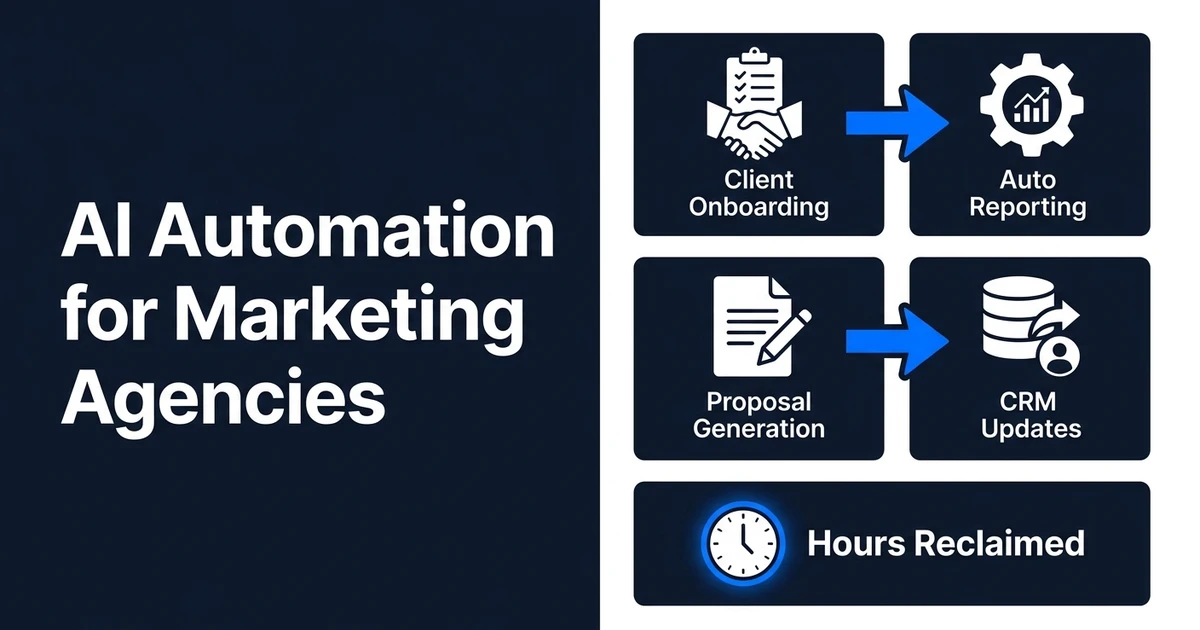
Quick Answer: AI automation for marketing agencies handles client onboarding, reporting, and proposal creation automatically, so account managers spend time on strategy rather than admin. Agencies typically recover 15-25 hours per week across the team once core internal workflows are automated.
For most marketing agencies, the work that keeps the business running has nothing to do with marketing.
Client intake emails. Manual status reports. Proposals built from blank templates. CRM notes entered after every call. These tasks are not billable. They do not improve client results. But they consume the same hours your team should be spending on the work clients actually pay for.
AI automation for marketing agencies addresses this gap directly, not by replacing your team, but by removing the layer of operational admin that sits underneath everything they do.
Where Marketing Agencies Bleed the Most Billable Hours
The operational burden in a small marketing agency is easy to underestimate until you add it up.
According to the 2025 Agency AdOps Benchmark Report from Fluency, which surveyed more than 75 independent advertising agencies, 55% of agencies rely on manual processes for budget pacing and operations, and teams spend more than 25% of their time, roughly 46 hours per month, making manual campaign adjustments and administrative updates.
That is more than one full work week per month, per team member, spent on work that could run automatically.
The biggest time drains in a typical agency fall into four categories:
- Client onboarding: Collecting briefs, assets, and approvals through email threads
- Reporting: Pulling data from multiple platforms and assembling it into a presentable format
- Proposal and contract creation: Building documents from scratch or from loosely maintained templates
- CRM and project management updates: Manually logging calls, emails, and status changes
Each of these is highly automatable. None of them require human judgment to execute.
What AI Automation Covers Inside a Marketing Agency
AI automation for marketing agencies focuses on the agency’s own internal operations, not on automating client campaigns. That distinction matters.
The workflows that deliver the most time back for agency teams typically include:
- Client onboarding sequences: Triggered automatically when a contract is signed, collecting assets and information without a human sending individual emails
- Automated report generation: Pulling data from ad platforms, analytics tools, and CRMs on a schedule, formatting it, and delivering it to clients without manual assembly
- Proposal generation: Auto-populating proposal templates from CRM data, reducing a multi-hour task to minutes
- CRM updates: Logging call outcomes, email exchanges, and project status changes automatically after every interaction
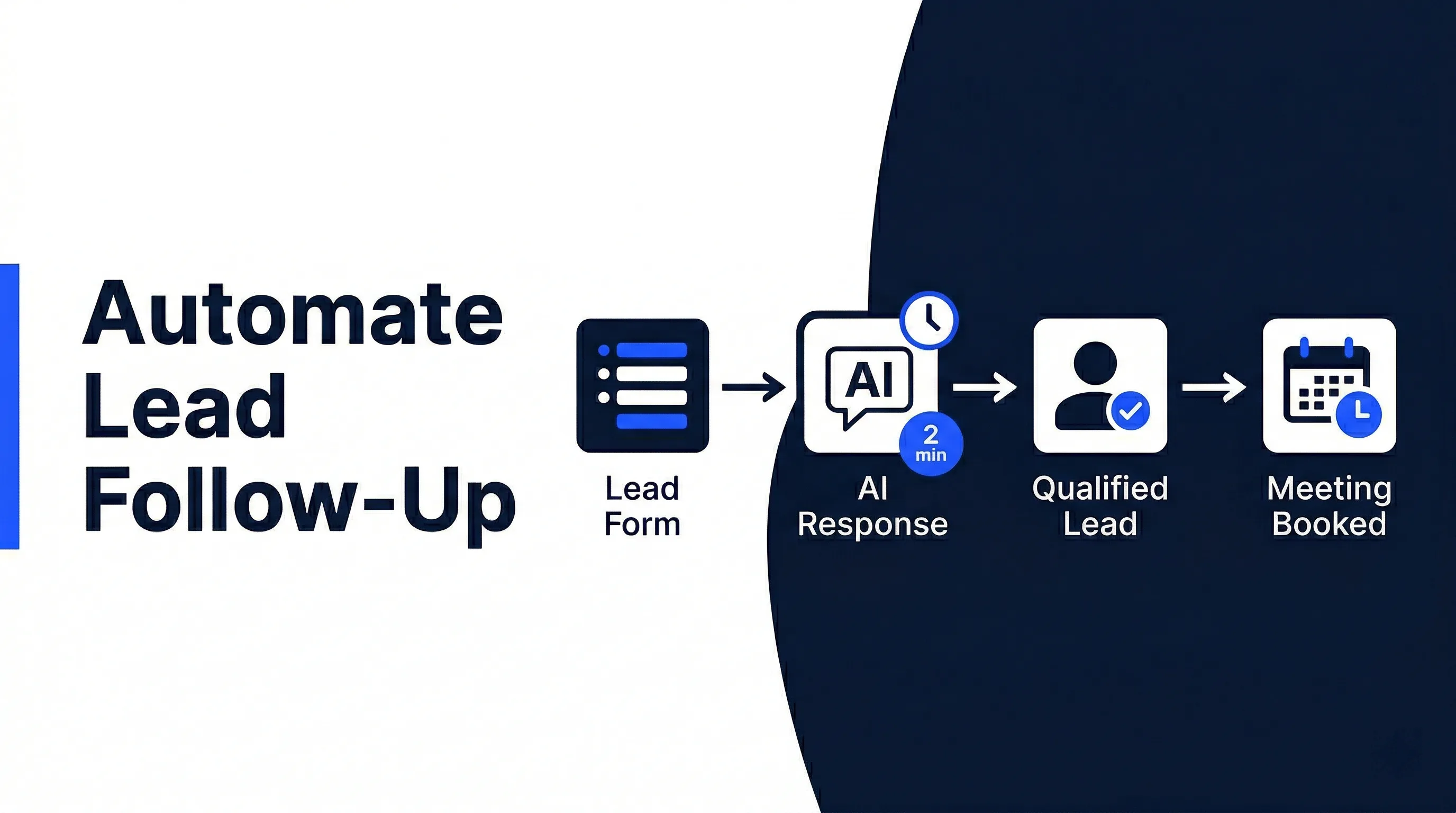
- Lead and inquiry follow-up: Ensuring new business inquiries receive an immediate response even when the team is heads-down on client work
Explore AI automation solutions for marketing agencies to see which of these workflows applies to your current operational structure.
Client Onboarding Without the Back-and-Forth
Client onboarding is one of the most chaotic and time-consuming processes in a marketing agency, and one of the easiest to automate.

A typical manual onboarding looks like this: a contract is signed, and then over the next one to two weeks, someone chases the client for brand assets, access credentials, messaging guidelines, and approval on the project brief. Every item is a separate email. Every delay pushes the launch date.
An automated onboarding workflow changes the sequence entirely:
- Contract is signed (or a trigger of your choice fires the workflow)
- Client receives a structured intake form requesting all required information and assets
- Assets are automatically organized into a shared folder
- Your CRM record is updated with client details and project stage
- A kickoff meeting invite is sent based on the client’s availability
The entire onboarding sequence runs the same day the contract is signed, without anyone on your team sending a single manual email. New client files are ready before your first call.
This is also where AI CRM updates pay off immediately. Every new client record is complete and current from day one, rather than populated manually over the following two weeks.
Want to see how this looks inside your current tools? See how Automiq AI automates client onboarding and reporting for marketing agencies.
Automated Client Reporting and Deliverable Tracking
Client reporting is where marketing agency hours go to disappear. Pulling numbers from Google Analytics, Meta Ads Manager, LinkedIn, and your CRM, then formatting them into a readable document, is a process that repeats every month for every client. For an agency with several active retainer clients, the cumulative manual reporting time each month is significant, and it produces no new client value.
Automated reporting works by connecting your data sources to a reporting template. On a set schedule, the system pulls current data, populates the template, and delivers the report to the client, or to your team for a final review before sending. The manual assembly step is eliminated entirely.
For agencies that include commentary and interpretation alongside the data, automation handles the data layer while your team focuses on the narrative. Clients get consistent, on-time reports. Your account managers spend their time on insights, not spreadsheets.
Proposal and Contract Generation at Speed
Building proposals manually is a problem almost every small agency has but few have solved. A proposal that should take 30 minutes takes three hours because you are pulling information from multiple places, reformatting a previous proposal, and manually entering client-specific details.
AI proposal generation automates the assembly step. When a new prospect is qualified, the system pulls their details from your CRM, populates your proposal template with the relevant service packages and pricing, and produces a formatted document ready for review.
Your team reviews and personalizes the output. The strategic thinking stays human. The two hours of copy-paste work disappears.
The same logic applies to contracts and statements of work. When the document structure is consistent and the variables are known (client name, project scope, start date, pricing), automation produces the first draft in seconds.
Done-for-You Automation vs. Building It Yourself
Most agency owners who look into automation eventually find Zapier, Make, or a similar tool. The technology works. The question is whether your team should be the one building and maintaining it.
Here is an honest comparison:
| DIY Platforms | Done-for-You (Automiq AI) | |
|---|---|---|
| Setup time | Weeks to months | 1-2 weeks |
| Technical knowledge required | Moderate to high | None |
| Ongoing maintenance | Your team’s responsibility | Included |
| Strategy layer (what to automate first) | None | Included |
| Cost model | Monthly subscription per seat/task | One-time fixed fee |
If your agency has a technical operations person who enjoys building and maintaining workflows, a DIY approach can work well long-term. For most agencies at the 2-15 person stage, that person does not exist, and the build becomes another uncompleted project on someone’s list.
A Deloitte study on AI-powered workflow automation found that organizations using specialist-built automated workflows report 36% efficiency gains through time savings and cycle time reduction, with sales and client management teams recovering up to 43% of their time. Those results come from systems built and maintained by specialists, not from DIY tools left to accumulate technical debt.
Automiq AI builds the automation inside your existing tools and hands you a working system. You do not need to learn a new platform or dedicate internal resources to maintaining it.
What Implementation Looks Like for a Marketing Agency
Here is a realistic scenario. A ten-person agency has three account managers. Each spends roughly four hours a week on manual reporting and two hours on proposal assembly. Onboarding new clients takes one to two weeks of back-and-forth. New business inquiries sometimes go unanswered for 24-plus hours because everyone is on client work.
After automating the core workflows:
- Every new business inquiry receives an automated response within minutes
- New client onboarding triggers automatically the day a contract is signed
- Monthly reports are generated and delivered on schedule without manual assembly
- Proposal drafts are produced from CRM data in minutes, not hours
- CRM records update automatically after every call and email
The time recovered across the three account managers, roughly 15-18 hours per week, goes directly back into client strategy, campaign management, and new business development. See pricing and packages to understand what this type of implementation costs.
Frequently Asked Questions
What does AI automation for marketing agencies actually automate?
AI automation handles the internal operational tasks that eat into billable hours: client onboarding admin, scheduled reporting, proposal generation, CRM updates, and follow-up sequences. It removes the work that prevents your team from doing their actual jobs.
How much time can a marketing agency recover with AI automation?
It depends on how much manual admin your team currently handles. Agencies that automate reporting, onboarding, and proposal workflows typically recover 10-25 hours per week across the team. That time goes directly into client strategy and delivery.
Will AI automation integrate with our existing tools?
Yes. Automation is built to connect with the tools you already use, HubSpot, Pipedrive, Gmail, Google Drive, Slack, and project management platforms. You do not adopt new software. The workflows connect to your existing stack.
Is AI automation right for a small marketing agency?
It is particularly well suited to agencies with 2-15 people, where the same person often handles account management, reporting, and proposals. Automation lets a small team operate at a scale that would otherwise require additional hires.
How long does implementation take for a marketing agency?
A done-for-you implementation typically takes one to two weeks from discovery call to live system. No technical knowledge is required from your team. A specialist builds the workflows inside your existing tools and delivers a running system.
Can AI automation handle client onboarding for a marketing agency?
Yes. Automation can trigger intake forms, collect required assets, send welcome sequences, create project folders, and update your CRM, all automatically when a new client is signed. What used to take a week of back-and-forth happens on day one.
The Hours Are There. The Question Is Where They Go.
Every marketing agency has the same constraint: a finite number of billable hours and an operational admin layer that sits underneath all of them. The agencies that grow consistently are the ones that shrink that layer without shrinking their team.
AI automation for marketing agencies removes the manual reporting, the proposal copy-paste, the onboarding back-and-forth, and the CRM updates that no one enjoys doing. Your team does not disappear. They redirect into the work clients actually value.
Book a free discovery call to map out which admin workflows Automiq AI would automate in your agency first, and what your team could do with those hours back. Book your free discovery call