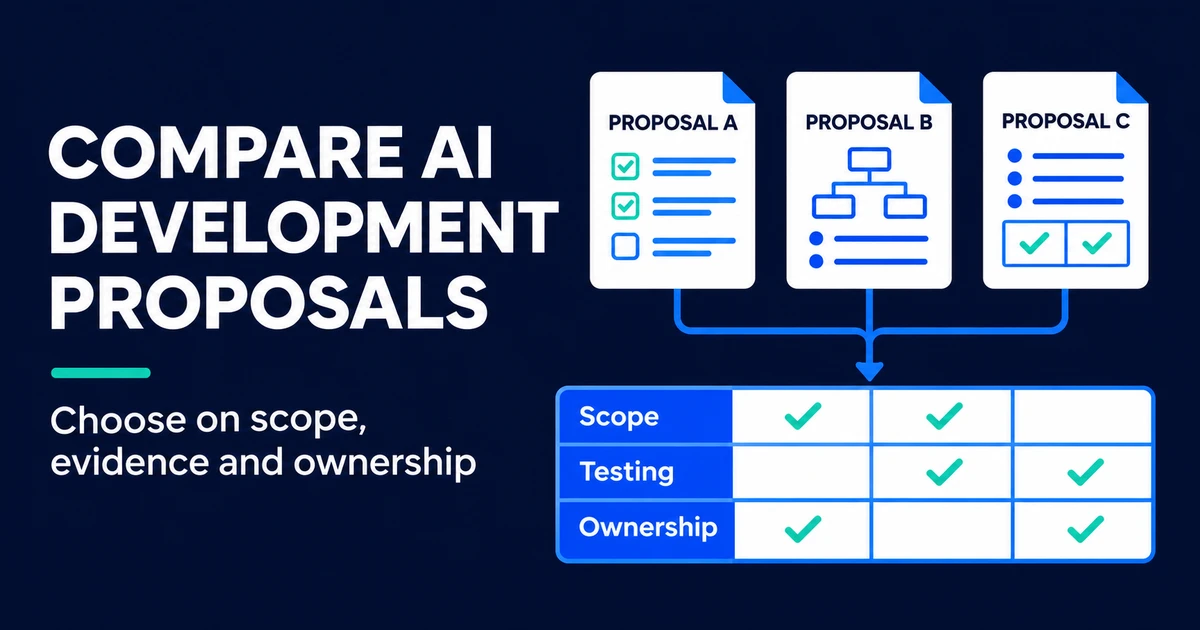
Quick Answer: To compare AI development proposals, first put every proposal on the same scope, then score each one against the same questions: how quality will be tested, what the system is allowed to do, where your data goes, who handles model changes, what it costs to run, who owns the result, and who will actually do the work. A lower price only means something once scope, testing, and running costs match.
You asked for proposals and received three documents that look nothing alike. One is a two-page quote. One is a forty-page plan full of acronyms. One promises “an intelligent agent” for a fixed fee. The price gap between them tells you very little, because they may not be offering the same thing.
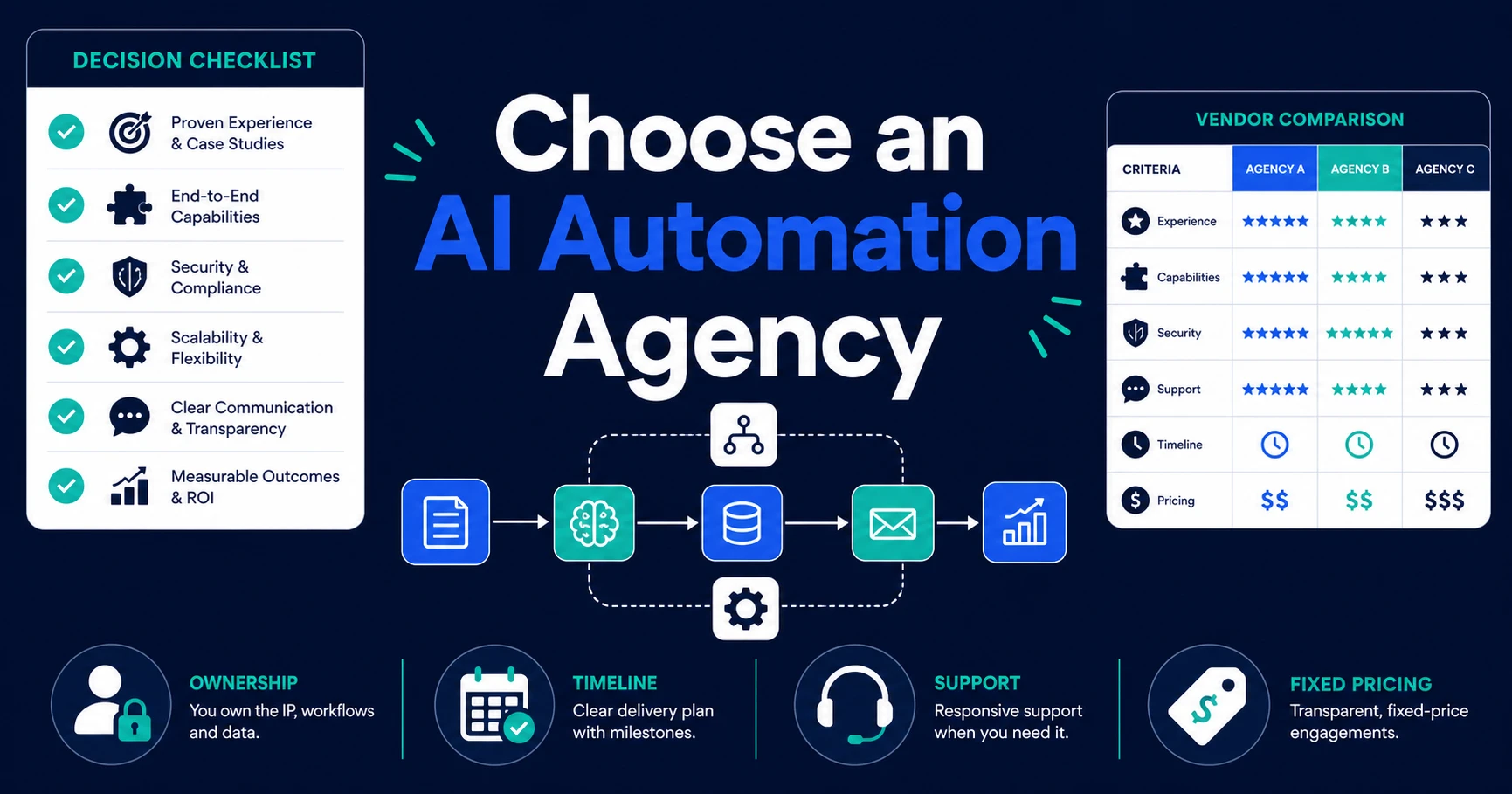
This guide gives you a way to line them up. It covers eight checks, a scorecard you can copy, and the signs inside a document that a proposal is thinner than it looks. For judging the company behind a proposal, our guide to choosing an AI automation agency covers the vendor side. This one is about the document in front of you.
Last checked against the linked sources on 20 November 2026. AI platform terms and prices change often, so confirm the details that matter before you sign.
Why AI Proposals Are Hard to Compare
AI projects add variables that ordinary software quotes rarely cover. Quality depends on test data, behavior depends on a third-party model that can change, and running costs depend on usage. A proposal that ignores these can still look cheaper.
The risk is real. Gartner predicted in July 2024 that at least 30% of generative AI projects would be abandoned after proof of concept by the end of 2025, citing poor data quality, inadequate risk controls, escalating costs, or unclear business value. That is a forecast, not a measured rate, and the press release does not describe how the figure was derived. Still, the four causes map neatly onto what a good proposal should address.
RAND’s study of AI project failures, based on interviews with 65 experienced data scientists and engineers, names similar causes. They include misunderstood business problems, too little high-quality data, chasing technology over the problem, and weak infrastructure. Each of those is something you can check in writing before you hire.
Step 1: Put Every Proposal on the Same Scope
Before you compare anything else, make the proposals describe the same project. Write a one-page scope sheet that names the problem, the users, the systems the solution must connect to, and what “done” looks like. Send it to every vendor, along with the same list of questions.
Then lay the answers side by side and look for differences in:
- Deliverables: what you will actually receive, such as working software, documentation, or a prototype
- Assumptions: what the vendor expects you to provide, such as data, access, or decisions
- Exclusions: what is left out, which is where a cheaper quote can differ from a dearer one
- Timeline and milestones: when you can see working progress, not only when it ends
Two proposals that differ on these points are not offering the same project, so their prices cannot be compared yet. The U.S. government’s 18F team makes a similar point in its questions to ask guide, which asks buyers how they will know the project is on track and what users will receive within six months.
Step 2: Check How Quality Will Be Measured
A proposal for an AI system should explain how anyone will know it works. That means an evaluation, often shortened to “eval”: a set of realistic test cases with a clear pass mark.
Anthropic’s documentation says building a successful AI application starts with defining success criteria and designing evaluations to measure performance against them, and that tests should be specific to your task and include edge cases. OpenAI’s evals guide calls evaluations an essential component of building reliable applications, especially when switching or upgrading models.
Look for answers to these questions in each proposal:
- Who builds the test set, and does it use your real examples, including awkward ones?
- What measurements count as success, and what is the pass mark?
- How often are the tests re-run, and what happens when they fail?
- Who owns the test set afterwards?
A proposal that says only “we will test thoroughly” has not answered any of them. A proposal that names the measures and the pass mark has done work the others have not.
Step 3: Look at What the System Is Allowed to Do
AI systems can take actions, not only produce text. The more power a system has, the more a mistake costs, so ask what the system can do on its own.
The OWASP Top 10 for LLM Applications is a widely used list of the main risks. Four matter most to a buyer:
- Prompt injection: someone tricks the system with crafted input into ignoring its instructions
- Sensitive information disclosure: the system reveals data it should not
- Excessive agency: OWASP describes this as damaging actions performed in response to unexpected, ambiguous, or manipulated outputs, and lists excessive functionality, permissions, and autonomy as root causes
- Unbounded consumption: usage runs away, which is both a security and a cost problem
A good proposal states which actions need human approval, what permissions the system gets, and how it handles untrusted input. NIST’s AI Risk Management Framework is a voluntary guide for managing these risks, and its Generative AI Profile applies it to generative AI. You do not need a vendor to recite them. You need to see that they considered the questions they raise.
If you serve customers in the EU, also ask which risk category the vendor believes the system falls into under the EU AI Act, which sorts systems into unacceptable, high, limited, and minimal risk. Timelines have shifted, so confirm current dates with a lawyer rather than relying on a proposal.
Step 4: Find Out Where Your Data Goes
Many AI products send your data to a model provider, and the provider’s terms decide what happens to it. A proposal should say which provider, on which plan, with which settings.
The defaults differ, and the plan matters:
- Anthropic says it does not use inputs or outputs from its commercial products to train models by default, and deletes them from its backend within 30 days with listed exceptions.
- OpenAI says data sent to its API is not used to train its models unless you opt in, and that abuse monitoring logs are kept for up to 30 days by default.
- Google’s Gemini API terms differ between paid and unpaid services. Paid services do not use your prompts and responses to improve Google products, while unpaid services may.
The lesson is that a free or consumer tier can carry different terms from a business or API plan. Ask each vendor to name the provider and plan, where data is processed, how long it is kept, who holds the account, and which subprocessors touch it. If a vendor mentions SOC 2, remember that it is an examination by a CPA of a service organization’s controls. Ask which organization was examined, what the scope was, and the report date, because a certificate covers a company’s controls, not your product.
Step 5: Ask Who Pays When the Model Changes
AI models are retired on a schedule, so an app that depends on one will need updating. This is a cost a proposal can easily leave out.
Anthropic’s deprecations page says it regularly retires older models and gives at least 60 days’ notice before retirement for publicly released models. OpenAI’s deprecations page says generally available models get at least 6 months’ notice unless safety or compliance needs a faster timeline, and that preview models may be retired on much shorter notice.
So ask each vendor:
- Who watches for deprecation notices, and who holds the account that receives them?
- Who re-runs the tests and migrates to a replacement model?
- Is that work included in the price, or billed separately?
Anthropic’s deprecations page also advises testing replacement models on your own tasks well before the retirement date, which is another reason the test set in Step 2 matters.
Step 6: Compare Pricing Models and Running Costs
You are comparing two different costs: the price to build, and the cost to run.
Build price. Fixed price, time and materials, and retainers shift risk differently. An archived 18F guide to buying development services argues that time and materials with a not-to-exceed ceiling protects the buyer better for custom software, because the vendor bills actual time and you can stop early and keep what was delivered. That is a U.S. public-sector view, not a universal rule. A fixed price suits a well-defined scope, and it suits you less when the work is uncertain. Ask each vendor how scope changes are priced, since 18F’s list of questions asks directly how much change orders will cost. For an example of how engagement models can be laid out, see how Automiq AI scopes and prices its work.
Running cost. AI services usually charge per token, a small unit of text, and prices vary by model. Anthropic’s pricing page lists input and output tokens separately and describes a batch option that offers a 50 percent discount for asynchronous processing. Prices change, so do not rely on figures in a proposal that are not dated. Ask for an estimate based on your expected volume, the assumptions behind it, and usage caps or budget alerts, which also address OWASP’s unbounded consumption risk.
Step 7: Check Ownership and Contract Terms
Ownership has three layers: the code, the AI outputs, and the accounts.
- Code and deliverables. 18F’s list includes the plain question who will own the software. UK government guidance on AI procurement, published in 2020, adds that buyers should decide who owns new IP such as models retrained on their data, and require knowledge transfer so staff can run the system independently.
- AI outputs. Anthropic’s commercial terms state that the customer owns its outputs. Copyright is a separate question. The U.S. Copyright Office’s report on copyrightability concluded that outputs are protectable only where a human author contributed sufficient expressive elements, and that prompts alone are not enough. If much of what you are paying for is AI-generated, ask how much human authorship goes in, and do not assume ownership rights you have not confirmed.
- Accounts and keys. Ask who holds the model provider account, the hosting account, and the repository. If the vendor holds them, you will need a clear handover plan.
Contract language is a legal matter. Have a lawyer review ownership, termination, and data terms before you sign.
Step 8: Test the Team, Not Just the Document
A well-written proposal does not guarantee that the same people will do the work. 18F’s buying guide says actual code is a far better indicator of similar experience than bake-offs or hackathons, and recommends interviewing the key people to confirm the written proposal. A private buyer can adapt that:
- Ask for working examples of similar projects, with someone you can speak to
- Meet the people who will do the work, not only the person who sold it
- Ask how often work is deployed and how you will see progress
- Ask what happens if the relationship ends: how hard is it to terminate, how long would a replacement take, and what would it cost
Some of these questions come from 18F’s guides, adapted here for a private buyer, and the answers can tell you more than a polished document does.
A Scorecard You Can Copy
Score each proposal from 0 to 2 on each row: 0 if the proposal is silent, 1 if it answers vaguely, 2 if it answers specifically. Add the rows for each vendor, and use the total as a prompt for discussion, not a verdict.
| Criterion | A strong proposal says | A weak proposal says |
|---|---|---|
| Scope | Names deliverables, assumptions, and exclusions | ”Full AI solution” with no detail |
| Testing | Names the test set, measures, and pass mark | ”We will test thoroughly” |
| Permissions | States what the system can do alone and what needs approval | Does not mention it |
| Data handling | Names provider, plan, region, retention, and account holder | ”Secure and compliant” |
| Model changes | Says who monitors, migrates, and pays | Does not mention it |
| Running cost | Estimates cost at your volume, with usage caps | Quotes the build price only |
| Ownership | Names who owns code, outputs, and accounts | Is silent or vague |
| Team | Names the people and shows working examples | Offers only a sales presentation |
An Illustrative Example
This is a hypothetical scenario, not a case study. A services firm wants an assistant that drafts replies to customer emails. Proposal A is the cheapest and promises a working assistant in a few weeks. Proposal B costs more and includes a test set built from the firm’s past emails, a rule that the assistant drafts but a person sends, a named model provider on a business plan, and a clause covering model migration.
Scored side by side, Proposal A is silent on four rows and Proposal B answers all of them. Nothing in either proposal says B will build a better assistant, but B has described how the firm will find out, and who is responsible if the model changes. That is the information the lower price was hiding.
Red Flags Inside the Document
Watch for these as you read:
- Vague “AI-powered” language with no description of what the system does. Gartner has also warned about “agent washing”, where vendors rebrand chatbots and automation as agents.
- No exclusions listed. Everything appears included, so ask what is left out before scope is argued later.
- Accuracy promises with no way to measure them. A claim of “95% accuracy” is meaningless without a test set.
- No mention of running cost. The build is quoted and the usage bill is left for you to discover.
- No named people. You are buying a team, so the proposal should say who is on it.
How Automiq AI Approaches an AI Proposal
Hold Automiq AI to the same scorecard. Our engagement models price the production responsibility rather than a feature count, and they range from an assessment to a bounded build, embedded delivery, and continuing support.
On the questions this guide raises, our production AI work covers:
- Testing: evaluation cases built for the workflow, not a generic demo
- Permissions: integration design and permission boundaries around what the system can do
- Model changes: models treated as replaceable parts of the architecture, so a provider change is not a rebuild
- Ownership and handover: you should own the repository, infrastructure access, documentation, and evaluation process
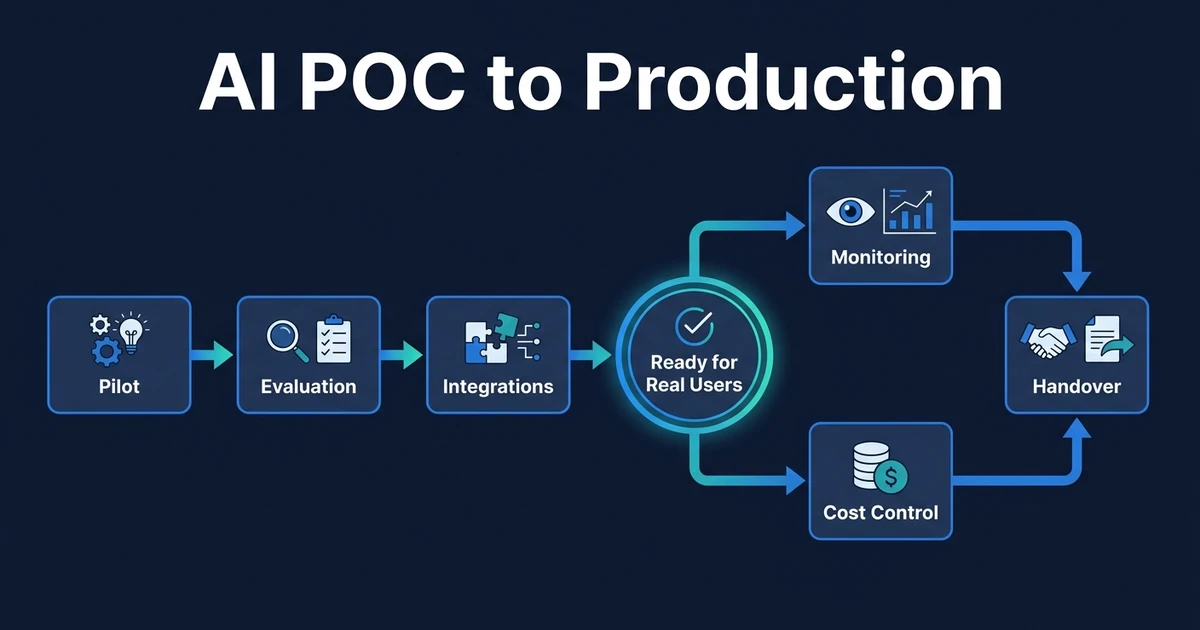
If you already have a working pilot, see our AI pilot to production approach. If you are adding AI to software you already run, see AI integration.
Frequently Asked Questions
How many AI development proposals should I collect?
Three is a practical number, since it is enough to see differences without making comparison unmanageable. What matters more is giving each vendor the same scope sheet so the answers can be compared.
Should I choose the cheapest AI development proposal?
Not on price alone. Compare scope, testing, data handling, model-change plans, and running costs first. A lower build price can hide higher costs later, such as separately billed migrations or usage fees.
Do I need a technical person to compare AI proposals?
Not for most of the checks in this guide, since they are questions you can ask in plain language. For the technical answers, an independent engineer can review the shortlisted proposals so you are not relying on the vendors alone.
What should an AI proposal say about data privacy?
It should name the model provider and plan, where data is processed, how long it is retained, who holds the account, and which subprocessors are involved. Provider terms differ between business and free tiers, so the plan matters.
Choose the Proposal That Answers the Hard Questions
The best proposal is not the longest or the cheapest. It is the one that says how success will be measured, what the system may do, where your data goes, who handles change, and who owns the result. Vendors who answer those clearly have at least thought about running the system after launch.
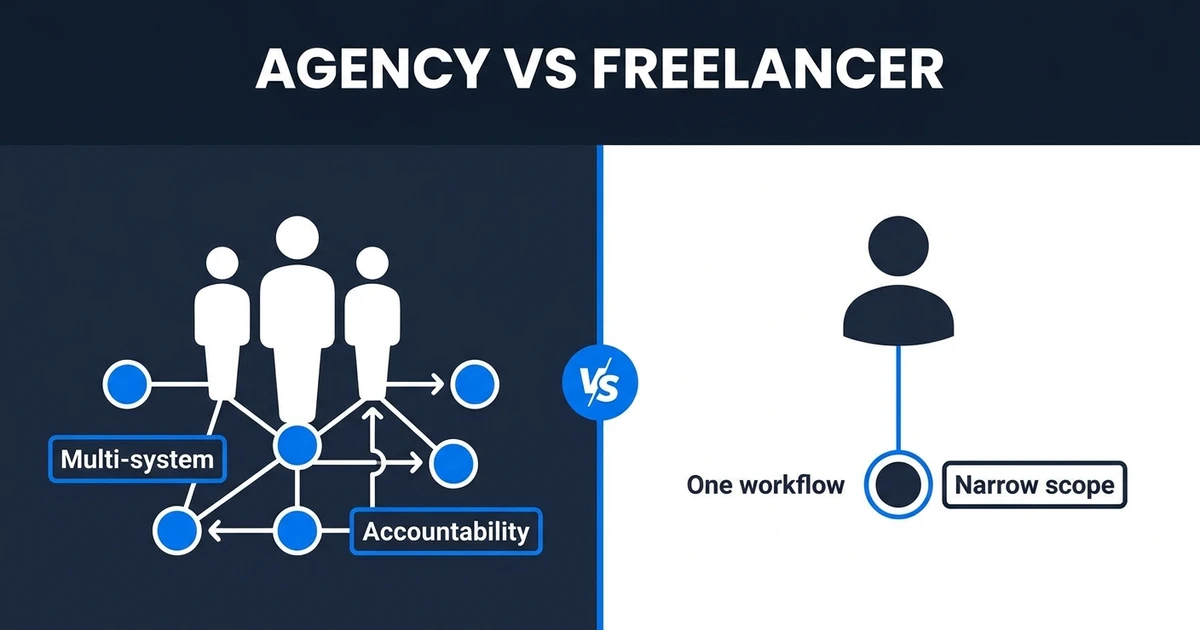
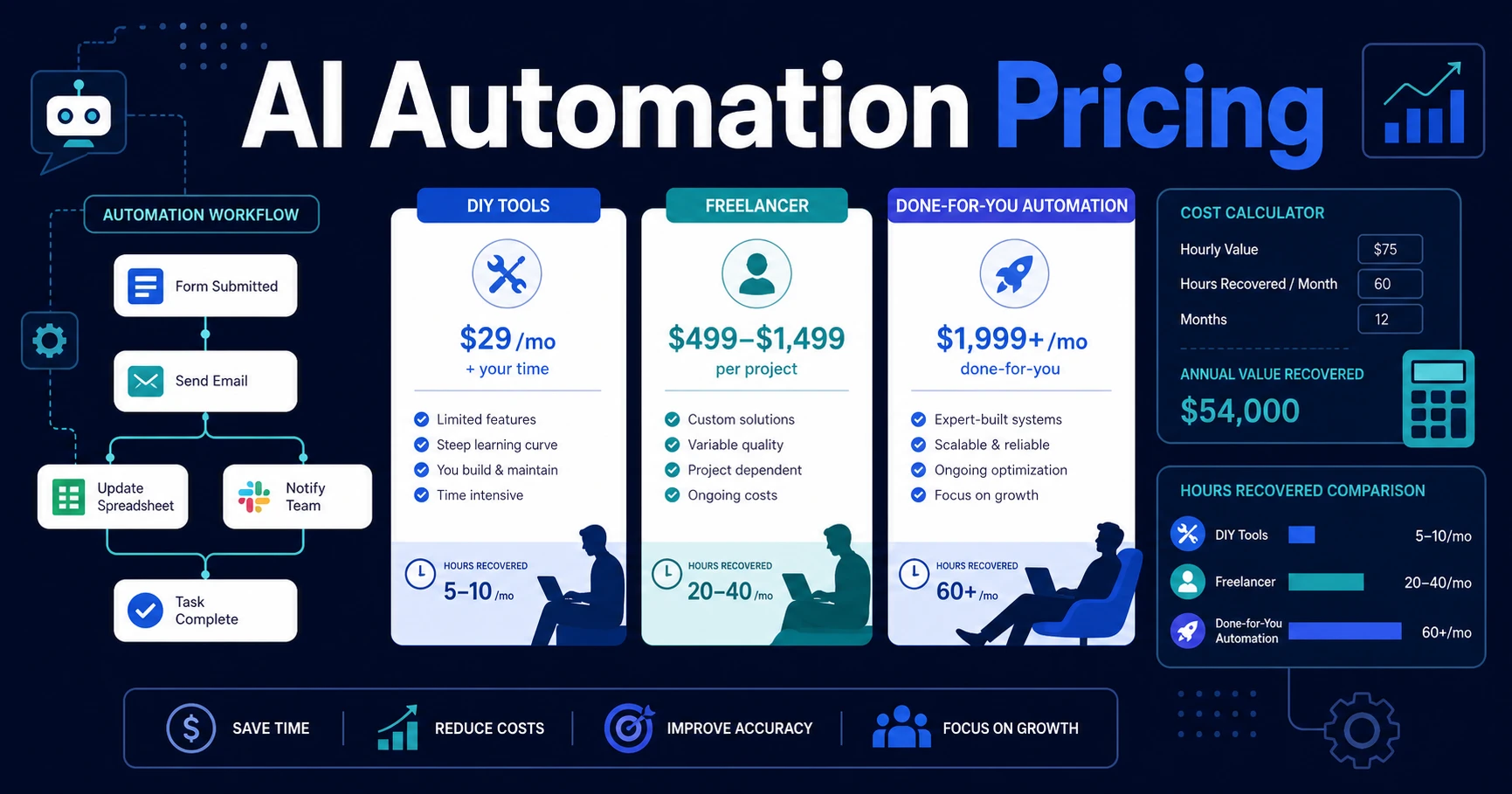
If you want a second opinion, book a 30-minute consultation and bring your scope sheet and shortlist, and we will pressure-test the requirement with you. You can also read about Automiq AI or see our custom software development work. For related reading, see our guides to AI agencies versus freelancers, AI automation pricing, and the AI proof of concept to production checklist.