EN
EN DE
DE ES
ES FR
FR NL
NL PT
PT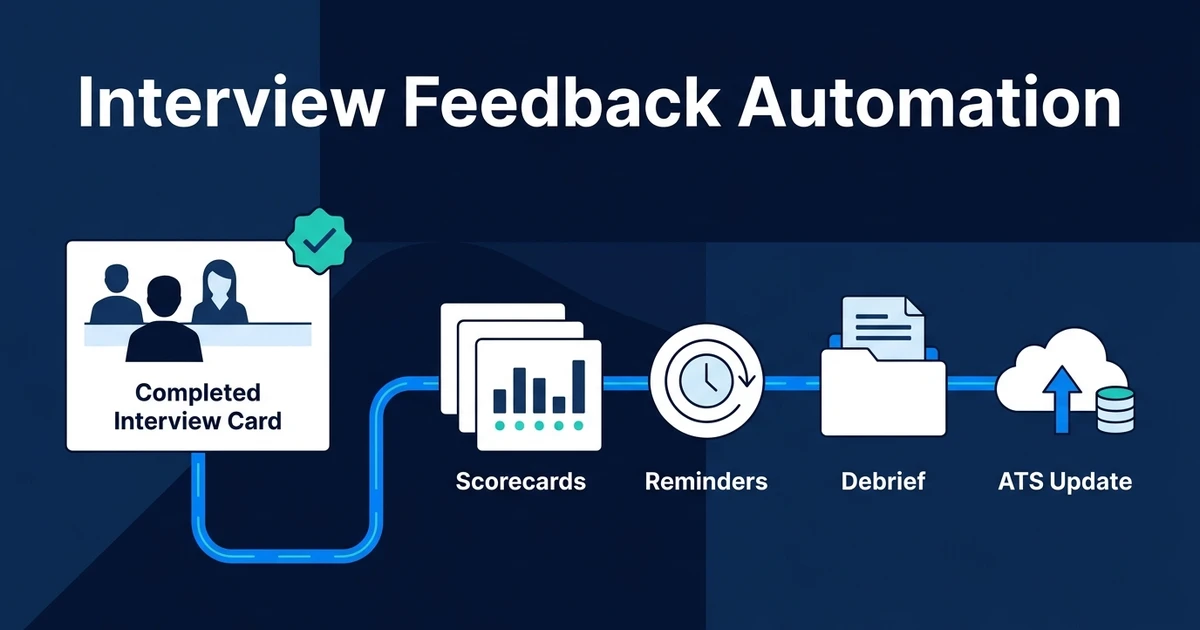
Quick Answer: Interview feedback automation requests scorecards as soon as an interview ends, reminds late interviewers, structures notes against an approved rubric, prepares a debrief view, and writes completed feedback to the ATS. It should organize evidence and expose missing input, while interviewers and hiring leaders retain every hiring recommendation and decision.
Interview feedback automation begins after the meeting ends. It closes the gap between “the interview happened” and “the hiring team has complete, structured feedback they can discuss.”
The workflow is useful because it handles coordination. It should not turn interview notes into an automatic hire or reject recommendation.
Why Interview Feedback Becomes the Next Hiring Bottleneck
Scheduling gets the attention, but feedback often becomes the next delay. Scorecards arrive late, notes sit in private documents, rubrics differ by interviewer, and debriefs happen with missing evidence.
The recruiter becomes the chase function. They remind the panel, copy notes into the ATS, prepare a debrief, and try to identify which feedback is missing before the candidate loses momentum.
LinkedIn reported that half of companies had interview processes longer than four weeks, 42% required five or more interviews, and it recommends feedback forms within 24 hours while impressions are fresh, according to its 2025 guidance on reducing time to fill.
The fix is not pressure. The fix is a workflow that asks for the right feedback at the right time and makes missing input visible before the debrief.
What Is Interview Feedback Automation?
Interview feedback automation is the post-interview workflow that requests scorecards, reminds interviewers, captures notes, checks completeness, prepares debrief material, and updates the ATS.
It is different from interview scheduling. Scheduling owns calendars and invitations. Feedback automation owns what happens after the meeting: evidence collection, scorecard completion, and debrief readiness.
It is also different from candidate screening. Screening may support evaluation before an interview. Feedback automation structures input from human interviewers after the interview has happened.
The workflow should improve coordination without replacing judgment. Interviewers still own their observations, recommendations, and final decision input.
How Does an Automated Interview Feedback Workflow Work?
A controlled post-interview workflow usually follows this sequence:
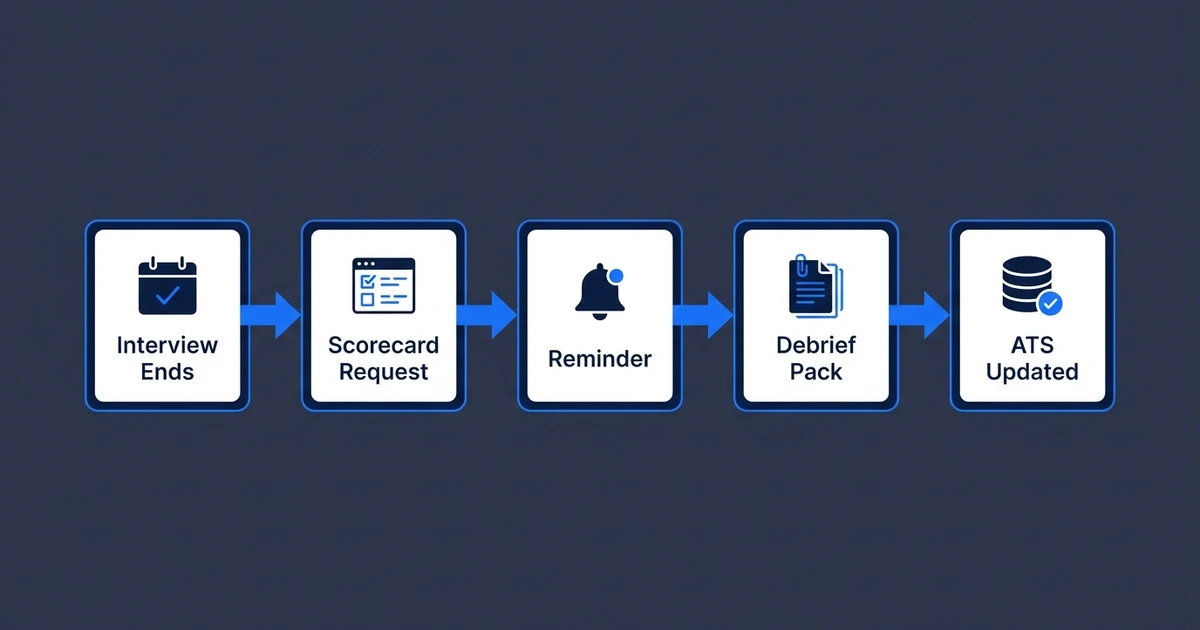
- The interview ends or the calendar event reaches completion.
- The workflow selects the correct scorecard for the role and interview stage.
- Interviewers receive a feedback request with the required rubric.
- Late scorecards trigger reminders and, if needed, escalation.
- Notes and transcripts are captured only under approved access rules.
- Completeness checks identify missing ratings, comments, or evidence.
- A debrief packet is prepared for the hiring team.
- Completed feedback writes back to the ATS.
The workflow should show which interviewer is missing which input. It should also preserve the time of submission, source, and any edits so the team can trust the record.
Exception logic matters. If an interviewer attended the wrong stage, if a scorecard is incomplete, or if a transcript is unavailable, the system should create a task instead of filling gaps with assumptions.
What Should an Automated Interview Scorecard Capture?
A useful scorecard captures role-specific competencies, evidence, rating scales, concerns, confidence level, and a recommendation field where appropriate. Required comments should explain the rating, not merely repeat it.
Every interviewer should not rate every competency. A technical interviewer may assess skill depth while a hiring manager assesses team fit and role scope. Forcing everyone through the same generic scorecard creates noise.
The scorecard should separate observations from conclusions. “Candidate described managing a payroll migration” is evidence. “Candidate can lead our implementation” is a recommendation that needs context.
Structured feedback also supports cleaner debriefs. The hiring team can compare evidence by competency instead of reading long notes in several formats.
How Should Reminder and Escalation Rules Work?
Reminder rules should be prompt but not hostile. Send the first request when the interview ends, then remind based on agreed timelines, interviewer role, and debrief schedule.
Escalation should follow dependency. If one panelist owns a required competency and the debrief is blocked, the workflow can alert the recruiter or hiring manager. If a duplicate reminder would annoy a stakeholder who already submitted feedback, the workflow should stop.
Time zones and working hours matter. A reminder at the end of a person’s local workday may be more useful than a message triggered at an arbitrary global time.
The rule is simple: reminders should protect decision quality, not train interviewers to ignore the workflow.
Can AI Summarize Interview Notes Without Making the Decision?
Yes, but only with boundaries. AI can extract themes, organize notes against the rubric, flag unsupported statements, and prepare a debrief summary for confirmation.
It should not create final facts from unclear notes. If a transcript says the candidate “may have led” a project, the workflow should preserve uncertainty or ask the interviewer to confirm.
LinkedIn reported that 93% of talent acquisition professionals said accurate skills assessment is crucial to improving quality of hire, and its Future of Recruiting report frames AI as support for human judgment, according to the 2025 report.
If you want scorecard reminders, controlled summarization, and ATS write-back built without automating hiring decisions, Automiq AI can build done-for-you interview feedback automation inside the tools your team already uses.
What Does Interview Feedback Automation Look Like for a Panel?
Consider a panel where each interviewer covers a different part of the role: technical skill, team leadership, client communication, and operating style. In the manual version, each person writes notes in their own format and sends them at a different time.
The recruiter then hunts for missing comments, copies notes into the ATS, and builds a debrief agenda from uneven evidence. The team may meet before all required input is complete.
In the automated version, each interviewer receives the correct scorecard when the meeting ends. Missing fields are flagged, late input triggers reminders, and the debrief view shows the panel’s evidence by competency.
The hiring team still debates the decision. Automation simply makes sure the debate starts with complete and traceable input.
Done-for-You vs DIY Feedback Automation vs Manual Chasing
The right setup depends on panel complexity and how much the ATS already supports.
| Approach | Best fit | Main tradeoff |
|---|---|---|
| Native ATS reminders | Simple interviews and standard scorecards | Limited when notes, transcripts, and debriefs live elsewhere |
| Manual chasing | Sensitive or rare hiring processes | Recruiter time becomes the workflow |
| Done-for-you workflow | Panels, custom rubrics, summaries, and ATS write-back | Requires scorecard ownership and access rules before launch |
Native reminders can work when one scorecard and one owner are enough. Start there if the missing-feedback problem is small.
DIY gets harder when feedback lives across calendars, video tools, documents, inboxes, and the ATS. Your team must test permissions, reminders, transcript handling, and failed writes.
A done-for-you build fits when feedback must become a reliable operating process. It should include scorecard design, reminder logic, confirmation rules, debrief packaging, and monitoring.
For the decision boundary before interviews, see our guide to recruiter-controlled candidate screening.
How Do You Evaluate an Interview Feedback Workflow?
Measure whether the workflow creates decision-ready evidence. Track scorecard completion time, missing fields, reminder volume, debrief readiness, evidence quality, interviewer adoption, ATS accuracy, and override rate.
Pilot one interview stage first. Test a completed scorecard, a late scorecard, an incomplete scorecard, a missing interviewer, a transcript access issue, and a debrief packet that should not be released yet.
LinkedIn recommends measuring candidate experience systematically instead of relying on anecdotes, according to its 2024 candidate experience guidance. Feedback workflows should be measured the same way.
If interviewers frequently ignore reminders or edit summaries heavily, the workflow needs adjustment. Good automation fits the panel’s work instead of forcing the panel to work around it.
Frequently Asked Questions
What is interview feedback automation?
It is the post-interview workflow that requests scorecards, reminds late interviewers, structures notes, prepares debrief material, and updates the ATS. It coordinates evidence collection without making the hiring decision.
Can automation remind hiring managers to submit scorecards?
Yes. It can send timed reminders, escalate overdue feedback, and stop when a scorecard is complete. The cadence should match the role, debrief timing, and stakeholder expectations.
Can AI summarize interview notes safely?
AI can summarize notes when the workflow preserves source evidence and requires interviewer confirmation. It should flag uncertainty rather than converting weak notes into confident claims.
Should AI recommend whether to hire a candidate?
No. AI can organize feedback and expose missing input, but recommendations and final decisions should remain with interviewers and hiring leaders.
Does feedback automation work with an existing ATS?
Yes. The workflow can use calendar completion or an ATS stage event as a trigger and write completed feedback, summary status, and tasks back into the candidate record.
Move From Interview to Debrief Without Chasing the Panel
Interview feedback should not depend on a recruiter manually following every interviewer. The process should ask for the right scorecard, remind the right person, and show whether the debrief is ready.
Keep the judgment human and automate the coordination around it. That balance gives hiring teams better evidence without pretending software can own the decision.
Book a discovery call to map scorecard ownership and escalation rules. Automiq AI will help define the reminders, summaries, approval gates, and ATS updates that move interviews to debrief without another chase cycle.