Product context
Recruitment teams need a shared system of record across talent, job requirements, client relationships, communication, and delivery.
Owned product case study · Recruitment SaaS
The story of the recruitment SaaS founded by Ayush Sharma: the product problem, system decisions, AI boundaries, operating complexity, customer reach, and lessons that now inform Automiq delivery.
Relationship disclosure
Ayush Sharma founded ATZ CRM. The case documents founder and product-operating experience; it does not imply that a separate customer commissioned the work from the newer Automiq AI venture.
Recruitment teams need a shared system of record across talent, job requirements, client relationships, communication, and delivery.
Boutique and growing agencies need useful depth without inheriting unnecessary enterprise complexity.
The product must remain usable through imports, daily recruitment work, customer support, evolving integrations, and continuous releases.
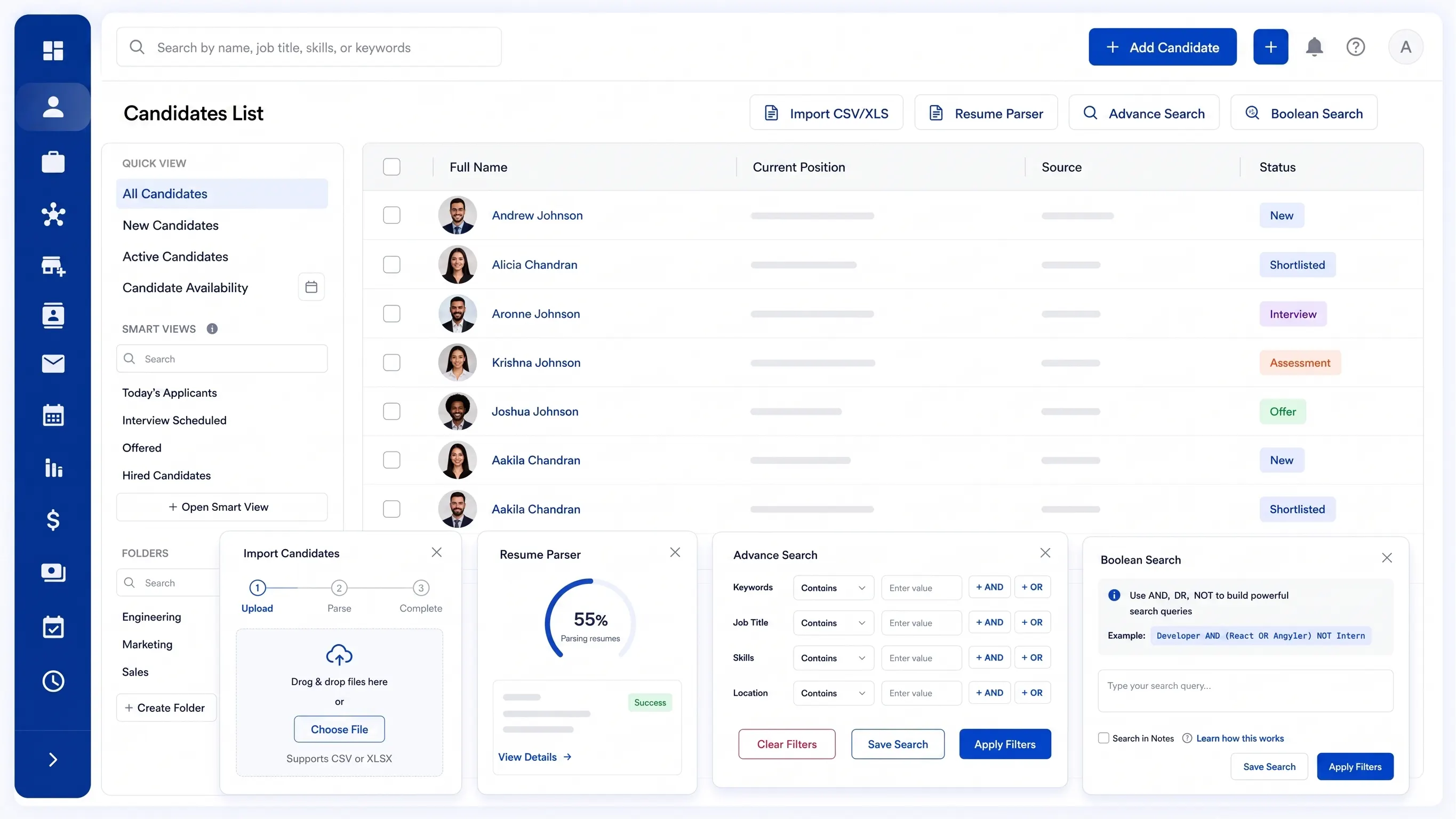
Product interface
Explore a representative product surface and the workflows behind it.
Initial problem
The case begins with operating context instead of reverse-engineering a story from a feature list.
Recruitment activity crosses profiles, resumes, jobs, companies, people, notes, email, calls, tasks, documents, and feedback.
Basic keyword search and inconsistent records made it difficult to rediscover relevant people when a new job arrived.
Sourcing, logging, follow-up, submissions, reporting, and staffing operations created repetitive state changes across tools.
Users & market
Product quality depends on understanding who acts, who decides, who is affected, and who resolves exceptions.
Search, evaluate, communicate with, submit, and progress candidates across jobs.
Manage client relationships, opportunities, workload, revenue context, and team performance.
Provide requirements, apply, review submissions, share feedback, schedule, and receive timely communication.
Founder role
The role and operating context behind the experience.
Ayush founded the product and is associated with its product direction and operating responsibility.
The founder perspective connects user problems, scope, adoption, support, roadmap, and commercial constraints.
The experience behind Automiq includes building and operating software where post-launch behavior influences the next technical decision.
Product design decisions
These decisions connect users, state, authority, edge cases, and ongoing operations.
Candidate, job, client, contact, activity, submission, and placement state need stable relationships instead of feature-level silos.
Search, matching, parsing, summaries, and drafting should surface context and remain correctable by recruiters.
Email, calling, meetings, notes, follow-up, and delivery outcomes need to live beside the relevant relationship.
Job boards, applications, candidate submissions, client review, and feedback require controlled interfaces beyond the internal CRM.
Engineering scope
The product, platform, integration, and operational concerns that shaped the work.
Candidate profiles, resumes, search, parsing, pipelines, notes, tasks, and activity history.
Requirements, owners, shortlists, interviews, feedback, offers, placements, and reporting.
Companies, contacts, business development, communication, opportunities, and relationship context.
Contextual search, matching, extraction, summaries, and drafting with human decisions.
Calling, transcription, email sequences, templates, follow-up, and delivery state.
Imports, portals, job publishing, staffing workflows, automation, permissions, and support tooling.
Architecture
Every caption states whether the view reflects public workflows or a representative domain pattern.
Relevant technologies
Explore technologies and platform choices relevant to products with similar users, workflows, and operating constraints.
web mobile
Custom React application development
Explore Reactweb mobile
Node.js backend and platform development
Explore Node.jsweb mobile
TypeScript product and platform engineering
Explore TypeScriptcloud data
PostgreSQL architecture, migration, and application development
Explore PostgreSQLai
Custom OpenAI development for production systems
Explore OpenAIcloud data
AWS software and production AI development
Explore AWSAI implementation
Useful AI needs clear inputs, evaluation, human review, fallback paths, and ownership.
Interpret recruiter queries beyond exact keywords and return inspectable candidate context.
Assist prioritisation and comprehension while recruiters retain selection and communication authority.
Structure resume or conversation context and draft routine content with validation and correction paths.
Challenges & tradeoffs
Tradeoffs show more engineering judgment than a polished final screenshot alone.
Mapping, duplicate resolution, partial records, inconsistent taxonomy, and source traceability affect every downstream workflow.
Recruiters need relevance across skills, seniority, location, history, and job context—not generic semantic similarity.
Email, calling, calendars, job channels, and external sources need observable status and explicit recovery.
Every customer request must be balanced against shared product behavior, support cost, and future maintainability.
Security & operations
These are engineering concerns, not legal advice, professional certification, or a claim about an unpublished private implementation.
AI assistance does not replace recruiter or employer responsibility for evaluation, communication, fairness, and employment decisions.
Candidate, client, job, communication, and reporting access require organization- and role-aware controls.
Source, edits, stage changes, communication, automation, and correction context should remain inspectable.
Imports, migrations, integration changes, and AI behavior need tests, monitoring, rollback, and support ownership.
Outcomes & lessons
The operating results and practical lessons that inform how Automiq approaches similar systems.
| Outcome | Result | Why it matters |
|---|---|---|
| Operating product | Live SaaS | A current product website and recruitment platform serve active agency workflows. |
| International reach | 30+ countries | Recruitment teams use the product across more than 30 countries. |
| Customer feedback | 10 Capterra reviews | Capterra displayed ten customer reviews when this page was reviewed on 16 August 2026. |
| Product depth | End-to-end workflow | Recruitment, CRM, communication, AI assistance, portals, and operations work in one connected product. |
Commercial relevance
Historical scope, duration, and investment are not reused as a quote. A new engagement is estimated from its own users, systems, data, risks, acceptance, and operating responsibility.
The first milestone is sequenced after the current system, dependencies, customer decisions, assurance needs, and release path are understood.
Investment depends on the accepted outcome, disciplines, integration and migration depth, production controls, third-party costs, handover, and support boundary.
Lessons learned
Relevance is explained without promising that a different product will have the same architecture or outcome.
Value comes from reliable relationships between people, work, communication, decisions, and outcomes.
Recruitment search and matching should be tested against recruiter expectations and corrected examples, not a generic demo.
Imports and onboarding determine data trust, adoption speed, and the support burden after launch.
Roadmap, reliability, support, billing, integrations, and maintenance influence architecture from the beginning.
More experience
Compare operating models, user workflows, technology choices, and product decisions across the catalog.
founded
Field services · B2B SaaS experience involving Web app, Mobile workflows, Payments, Automation.
founded
Rental operations · B2B SaaS experience involving Web app, Inventory, Payments, Automation.
Questions, answered
Direct answers about the relationship, technical scope, outcomes, and relevance to new product work.
No. ATZ CRM is a product founded by Ayush Sharma. The case study documents owned-product and founder experience that predates or sits alongside the newer Automiq venture.
The current product website, visible functionality, product screenshots, review-platform references, customer commentary, and a stated 30+ country footprint can be inspected publicly.
It demonstrates direct exposure to recruitment-product scope, connected data, AI-assisted workflows, integrations, SaaS operations, adoption, support, and roadmap tradeoffs. It does not prove identical results for a client project.
Talk to the engineering team
Bring your users, workflow, data, systems, constraints, and desired outcome. We will define a first production milestone without assuming your product should copy this one.