Product context
Service businesses need one current view from first request through completion and payment.
Owned product case study · Field service SaaS
A founder and product-operating story about field service software: how enquiries, quotes, scheduling, jobs, mobile evidence, invoicing, payment, and customer communication become one reliable workflow.
Relationship disclosure
Ayush Sharma founded Fieldified. Automiq presents it as owned-product and operating experience, not as work commissioned by an unrelated client.
Service businesses need one current view from first request through completion and payment.
Job reality changes away from the office, often with weak connectivity and evidence collected on personal devices.
Scheduling, travel, customer communication, technicians, invoices, and exceptions must remain coordinated throughout the day.
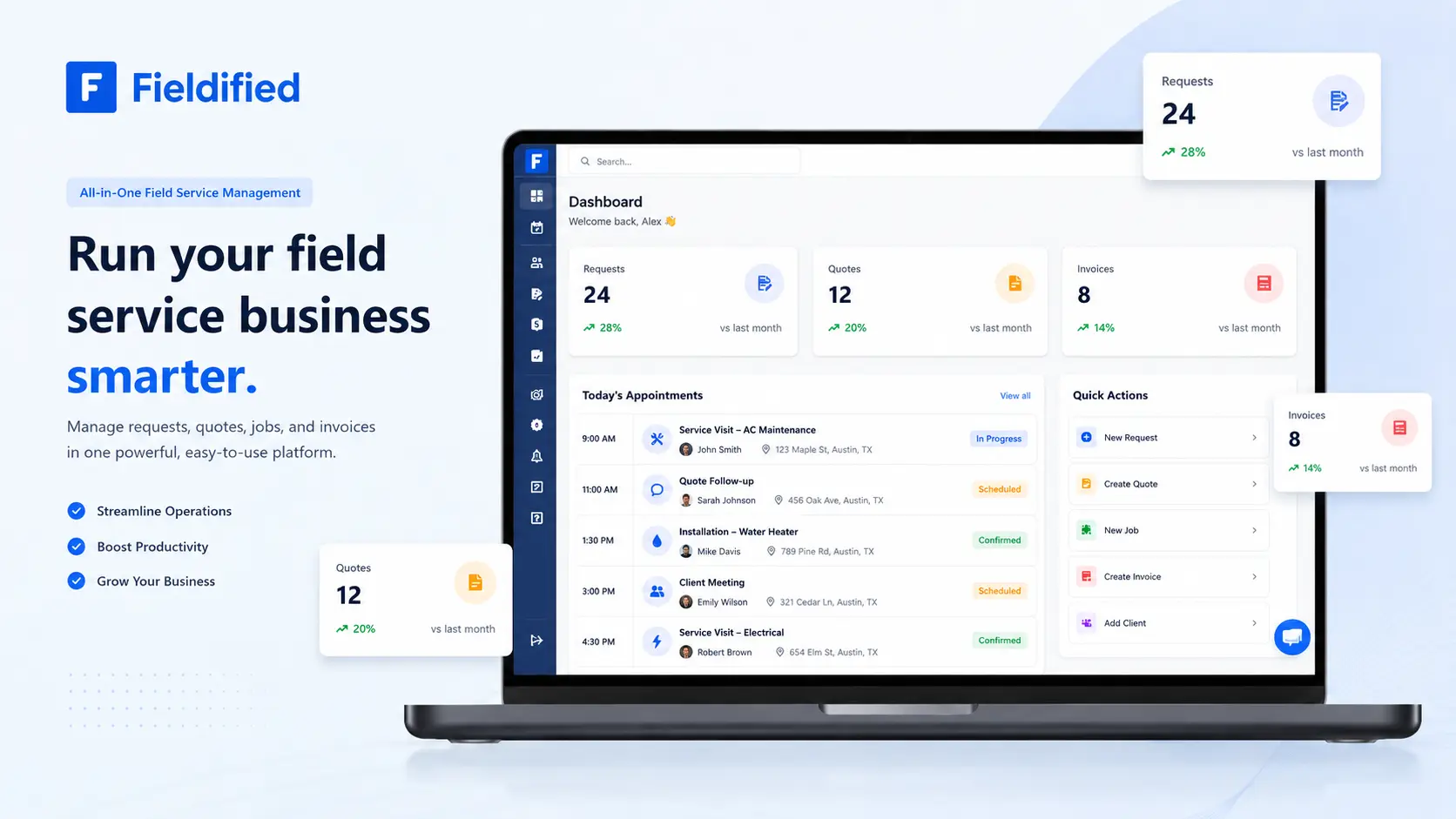
Product interface
Explore a representative product surface and the workflows behind it.
Initial problem
The case begins with operating context instead of reverse-engineering a story from a feature list.
Status, notes, materials, delays, evidence, and completion could remain trapped in calls and messages.
Customer, quote, job, invoice, and payment state could drift when separate tools owned each stage.
Skills, location, availability, urgency, travel, reschedules, incomplete work, and customer promises all affect dispatch.
Users & market
Product quality depends on understanding who acts, who decides, who is affected, and who resolves exceptions.
Need workload, customer, team, revenue, and exception visibility.
Coordinate enquiries, quotes, appointments, assignments, communication, invoices, and support.
Need clear jobs, customer context, navigation, notes, time, photos, signatures, and status updates on mobile.
Founder role
The role and operating context behind the experience.
Ayush founded Fieldified and brought product, market, and operating responsibility to the platform.
The product joins commercial and physical-service state instead of treating mobile work as a separate feature.
Support, connectivity, device behavior, schedule changes, and customer feedback inform the engineering model.
Product design decisions
These decisions connect users, state, authority, edge cases, and ongoing operations.
Lead, customer, quote, appointment, job, visit, evidence, invoice, and payment need stable shared state.
The technician flow needs focused actions, offline thinking, permissions, sync visibility, and recovery.
Messages should reflect current assignments, timing, job status, commercial state, and exception ownership.
Completed work, evidence, invoice state, payment, and reporting need one traceable chain.
Engineering scope
The product, platform, integration, and operational concerns that shaped the work.
Requests, contacts, sites, history, notes, communication, and follow-up.
Scope, pricing, approval, conversion, appointments, and confirmation.
Calendar, assignments, availability, changes, alerts, and exception handling.
Jobs, travel, status, time, notes, photos, signatures, and field evidence.
Invoices, collection, reminders, receipts, reconciliation context, and reporting.
Team access, notifications, dashboards, integrations, support, and product administration.
Architecture
Every caption states whether the view reflects public workflows or a representative domain pattern.
Relevant technologies
Explore technologies and platform choices relevant to products with similar users, workflows, and operating constraints.
web mobile
Custom React application development
Explore Reactweb mobile
Production React Native application development
Explore React Nativeweb mobile
Node.js backend and platform development
Explore Node.jsweb mobile
TypeScript product and platform engineering
Explore TypeScriptcloud data
PostgreSQL architecture, migration, and application development
Explore PostgreSQLcloud data
AWS software and production AI development
Explore AWSAI implementation
Useful AI needs clear inputs, evaluation, human review, fallback paths, and ownership.
Prioritize and suggest assignments within explicit skills, time, location, availability, and operating constraints.
Coordinate approved reminders and status communication while keeping delivery and escalation visible.
Summarize notes or surface missing evidence without replacing technician or operations judgment.
Challenges & tradeoffs
Tradeoffs show more engineering judgment than a polished final screenshot alone.
Queued work, simultaneous changes, timestamps, duplicate events, and visible sync state require deliberate design.
Emergency work, delays, travel, absence, customer changes, and incomplete visits challenge a static calendar.
Photos, signatures, locations, notes, and customer details need purpose, access, retention, and audit decisions.
Device permissions, versions, app distribution, backward compatibility, and support add continuing complexity.
Security & operations
These are engineering concerns, not legal advice, professional certification, or a claim about an unpublished private implementation.
Scheduling assistance cannot silently override safety, skill, working-hour, or customer decisions.
Customer, job, financial, location, and team information need purpose-based controls.
Identity, time, source, correction, and sync history protect the meaning of photos, notes, and signatures.
Offline queues, retries, conflict handling, manual fallback, monitoring, and support runbooks protect daily work.
Outcomes & lessons
The operating results and practical lessons that inform how Automiq approaches similar systems.
| Outcome | Result | Why it matters |
|---|---|---|
| Operating product | Live SaaS | A current field-service platform supports office and field workflows. |
| Connected experience | Web + mobile | Office teams and technicians work across purpose-built web and mobile surfaces. |
| Workflow coverage | Quote to payment | The product connects customer acquisition, scheduling, field delivery, invoices, payments, and follow-up. |
| Marketplace presence | Capterra listing | Fieldified has a product listing on Capterra. |
Commercial relevance
Historical scope, duration, and investment are not reused as a quote. A new engagement is estimated from its own users, systems, data, risks, acceptance, and operating responsibility.
The first milestone is sequenced after the current system, dependencies, customer decisions, assurance needs, and release path are understood.
Investment depends on the accepted outcome, disciplines, integration and migration depth, production controls, third-party costs, handover, and support boundary.
Lessons learned
Relevance is explained without promising that a different product will have the same architecture or outcome.
Fast actions, connectivity, device permissions, evidence, and recovery determine whether a mobile workflow survives daily use.
Every exception tests identity, authority, notification, reconciliation, and customer expectation.
Commercial and operational workflows become easier to trust when they share source records and transitions.
Real operators expose assumptions about travel, access, evidence, customer behavior, and incomplete work.
More experience
Compare operating models, user workflows, technology choices, and product decisions across the catalog.
founded
Recruitment · B2B SaaS experience involving AI, Web app, Workflow automation, CRM integrations.
founded
Rental operations · B2B SaaS experience involving Web app, Inventory, Payments, Automation.
Questions, answered
Direct answers about the relationship, technical scope, outcomes, and relevance to new product work.
No. Fieldified is a product founded by Ayush Sharma. Its value here is direct product and operating experience.
It demonstrates workflow thinking across scheduling, mobile field work, job records, communication, invoices, payments, integrations, weak connectivity, and product operations.
Yes. The team can apply these lessons to original field-service, scheduling, dispatch, mobile workforce, and quote-to-cash products.
Talk to the engineering team
Bring your users, workflow, data, systems, constraints, and desired outcome. We will define a first production milestone without assuming your product should copy this one.