The office cannot see field reality
Schedules, travel, job state, notes, photos, materials, approvals, and completion evidence arrive late or inconsistently.
Field service management software
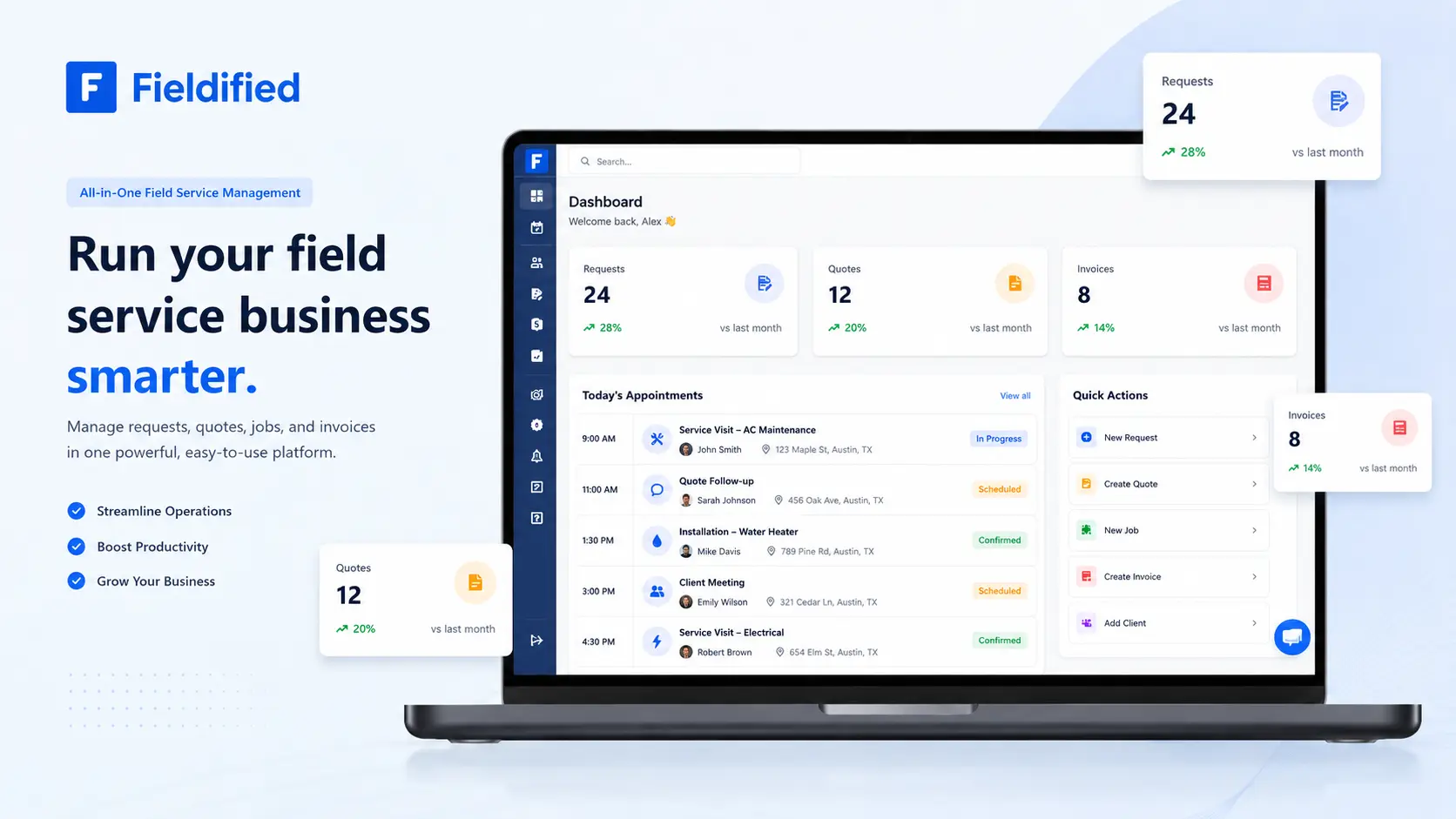
Fieldified is field service management software founded by Ayush Sharma. Its public product surface connects customer acquisition, quotes, scheduling, dispatch, field execution, evidence, invoicing, payments, and operational visibility.
Product interface
Screenshots come from the public product website and are shown as product evidence, not as an unrelated client deliverable.
Original market problem
A credible product overview starts with user work and system failure—not a generic feature inventory.
Schedules, travel, job state, notes, photos, materials, approvals, and completion evidence arrive late or inconsistently.
Leads, customer records, quotes, jobs, invoices, payments, and follow-up become duplicate administrative work.
Missed calls, uncertain arrival windows, reschedules, approvals, and payment reminders damage trust and increase support load.
Target users
The product organizes different responsibilities around shared operational state.
Growing plumbing, HVAC, electrical, cleaning, landscaping, maintenance, and similar teams.
Businesses coordinating recurring work, multiple customers, technicians, sites, quotes, invoices, and evidence.
Dispatchers, owners, technicians, finance, and support users who need one current operational view.
Core product modules
Current availability and commercial terms should always be checked on the live product website.
Service requests, prospects, customers, sites, communication history, notes, and follow-up ownership.
Service scope, pricing, approval, conversion, scheduling, reminders, and customer confirmation.
Calendars, assignments, technician availability, route context, rescheduling, alerts, and exception handling.
Job details, status, notes, time, before-and-after photos, signatures, navigation, and field-to-office updates.
Invoice generation, payment collection, receipts, reminders, financial status, and operational reporting.
Team access, automation, service visibility, dashboards, support, onboarding, and continuing product administration.
AI & automation
The product surface and responsible engineering boundaries are separated from speculative AI claims.
The public product describes AI-assisted scheduling while dispatch ownership and operating constraints remain visible to people.
Automate routine customer and team communication around approved events, timing, status, and escalation paths.
Summarize job notes and evidence for faster office review when source records remain available and correctable.
Surface overdue, conflicting, incomplete, or at-risk work without silently changing customer commitments or safety decisions.
System view
This explanatory model helps buyers reason about the product without pretending to disclose its private infrastructure.
Integrations
A connector is only useful when identities, source records, retries, exceptions, and support responsibility remain clear.
Invoice and payment state, refunds, fees, receipts, reconciliation, and accounting ownership.
Addresses, routes, notifications, calls, email, and customer messages with consent and delivery state.
Availability, assignments, changes, time zones, conflicts, reminders, and source-of-truth decisions.
APIs, webhooks, exports, imports, reporting, and workflow connections with monitoring and exception queues.
Architecture & scale considerations
These concerns come from operating software over time, not from claiming a private stack or universal scale milestone.
Field work needs queued actions, conflict rules, timestamped evidence, retry, and visible sync status.
GPS, photos, signatures, notes, and customer records need purpose limits, role access, retention, and audit.
Travel, skills, availability, duration, priority, and customer promises must survive reschedules and partial failure.
Device variation, permissions, app distribution, backward compatibility, support, and observability become continuing product work.
Product highlights
Key facts, market context, and operating lessons from building and running the product.
| Highlight | Value | Why it matters |
|---|---|---|
| Founder | Founded | Ayush Sharma founded Fieldified and brings its field-product operating lessons into Automiq. |
| Web and mobile | Live product | The product provides connected web and mobile workflows for office teams and field technicians. |
| Marketplace profile | Capterra | Fieldified has a product profile on Capterra. |
Investment and timeline
The time and investment required for a new engagement depend on its users, integrations, assurance needs, migration, release responsibility, and operating model.
Automiq reviews the current workflow or product, defines a bounded production outcome, records dependencies and customer decisions, and sequences acceptance and release gates.
Commercial scope follows the agreed milestone, disciplines, system access, data and integration work, quality controls, environments, handover, and continuing operating responsibility.
Operating lessons
The strongest credibility comes from the decisions and failure modes the team has had to understand over time.
A field app must handle evidence, connectivity, permissions, device behavior, and recovery—not merely mirror a desktop UI.
The calendar is the easy part; constraints, changes, travel, incomplete work, customer expectations, and ownership define the product.
Quotes, work, invoices, and payments need one traceable chain or the business spends its time reconciling systems.
A reminder or arrival update is only trustworthy when it reflects the current job, assignment, timing, and fallback path.
Relevant technologies
These links show Automiq capabilities and architecture choices buyers may need. They do not disclose or certify the product’s complete private stack.
web mobile
Custom React application development
Explore Reactweb mobile
Production React Native application development
Explore React Nativeweb mobile
Node.js backend and platform development
Explore Node.jsweb mobile
TypeScript product and platform engineering
Explore TypeScriptcloud data
PostgreSQL architecture, migration, and application development
Explore PostgreSQLcloud data
AWS software and production AI development
Explore AWSRelated case study
The case study focuses on context, decisions, operating challenges, outcomes, and lessons rather than repeating this product overview.
Founded by Ayush Sharma
Field services · B2B SaaS experience involving Web app, Mobile workflows, Payments, Automation.
Questions, answered
Direct answers about ownership, capabilities, AI responsibility, and how the experience relates to client work.
No. Fieldified is field-service SaaS founded by Ayush Sharma. The relationship is product ownership and operating experience.
Its public surface covers service requests, leads, customers, quotes, scheduling, dispatch, technician mobile work, job evidence, invoicing, payments, reminders, and reporting.
Yes. The public product describes mobile access to jobs, status updates, notes, time, photos, signatures, alerts, and navigation.
Yes. The experience can inform mobile, scheduling, offline, evidence, payment, integration, and operational architecture for original software serving the buyer’s own workflows.
Talk to the engineering team
Bring your users, workflow, market, constraints, and desired outcome. We will apply the operating lessons without copying another product’s code or business logic.