Recruitment data fragments quickly
Candidates, jobs, clients, notes, documents, email, calls, tasks, and submissions become disconnected across tools.
AI-powered recruitment ATS and CRM
ATZ CRM is an AI-powered recruitment ATS and CRM founded by Ayush Sharma. It brings candidate, job, client, business-development, communication, automation, and reporting workflows into one operating product for recruitment teams.
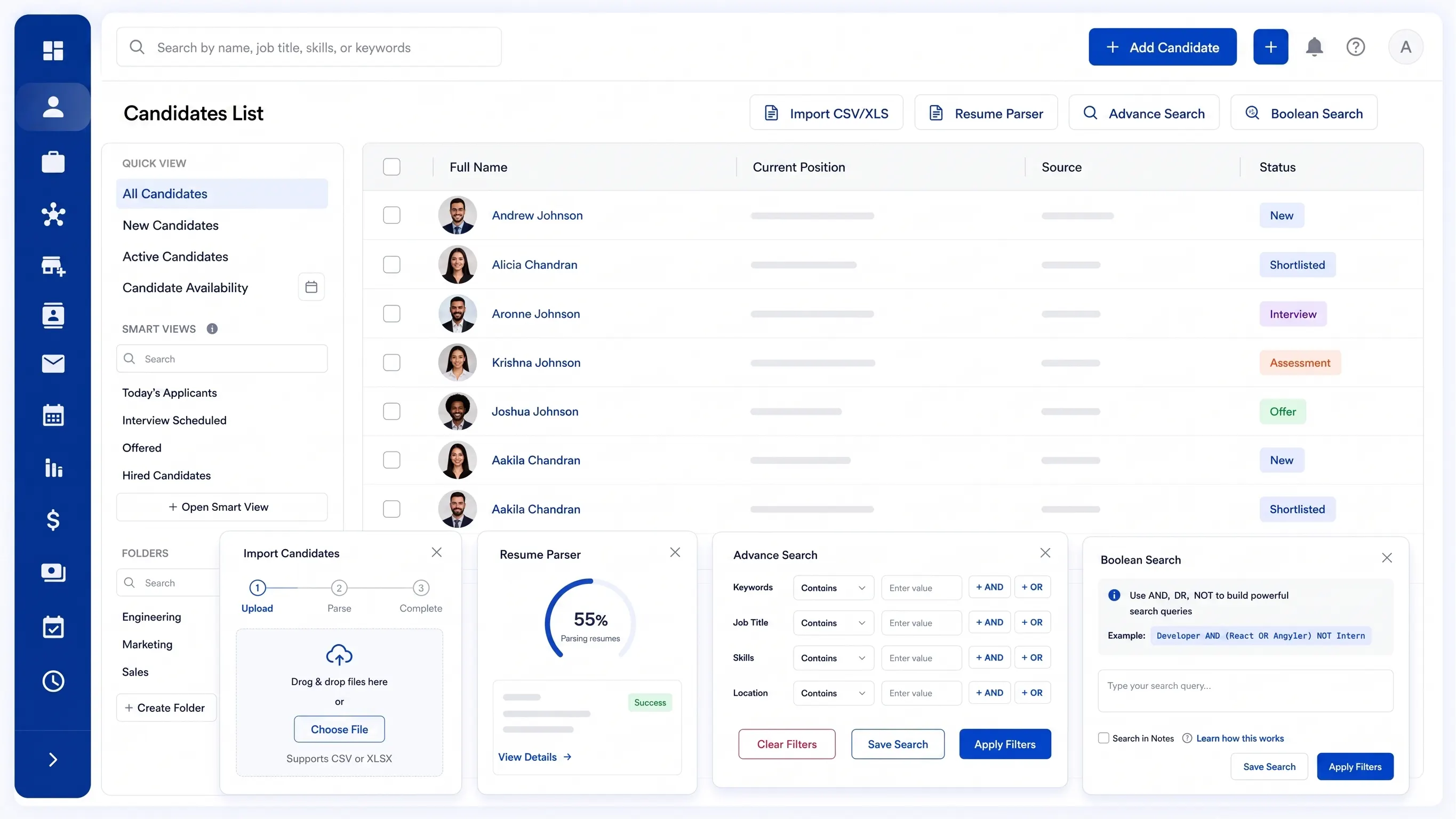
Product interface
Screenshots come from the public product website and are shown as product evidence, not as an unrelated client deliverable.
Original market problem
A credible product overview starts with user work and system failure—not a generic feature inventory.
Candidates, jobs, clients, notes, documents, email, calls, tasks, and submissions become disconnected across tools.
Keyword-only retrieval misses related skills, role context, career progression, and useful existing database candidates.
Sourcing, screening, submission, feedback, interviews, offers, and placement need one traceable history.
Target users
The product organizes different responsibilities around shared operational state.
Boutique and growing agencies coordinating candidates, jobs, clients, outreach, submissions, and placements.
Teams that also need timesheets, assignments, invoices, workforce records, and customer reporting.
People who need shared relationship history, tasks, pipelines, communication, and accountable next actions.
Core product modules
Current availability and commercial terms should always be checked on the live product website.
Profiles, resumes, notes, activities, search, parsing, deduplication, pipeline stages, and data ownership.
Requirements, owners, candidates, stage movement, tasks, interviews, feedback, offers, and placement context.
Companies, contacts, opportunities, sequences, meetings, communication history, and relationship reporting.
Supported imports, contact context, email sequences, follow-up, templates, consent, and delivery visibility.
Candidate reports, client review, feedback loops, branded job publishing, and application intake.
Assignments, timesheets, invoices, workflow automation, reporting, administration, and permissions.
AI & automation
The product surface and responsible engineering boundaries are separated from speculative AI claims.
Search and retrieval use skills, experience, role context, and recruiter intent while leaving selection with the recruiter.
Rank relevant profiles as decision support, with the underlying profile and job evidence available for review.
Turn resumes, calls, and recruitment records into structured fields or concise context with correction paths.
Draft job, candidate, and communication content inside approved workflows rather than acting as an autonomous hiring decision-maker.
System view
This explanatory model helps buyers reason about the product without pretending to disclose its private infrastructure.
Integrations
A connector is only useful when identities, source records, retries, exceptions, and support responsibility remain clear.
Communication sync, templates, scheduling, activity history, deliverability, authorization, and account-level controls.
Supported calling, recording, transcription, summaries, consent handling, and searchable conversation context.
Candidate import, job publishing, applications, identity matching, duplicate handling, and source attribution.
Rules, webhooks, workflow integrations, exports, reporting, and governed access to connected business systems.
Architecture & scale considerations
These concerns come from operating software over time, not from claiming a private stack or universal scale milestone.
Recruitment intelligence depends on normalized profiles, duplicate control, current records, source traceability, and evaluation.
Candidate and client data needs tenant isolation, role access, activity history, retention choices, and approved communication.
Email, calling, scheduling, and automation need delivery state, retries, opt-out handling, and visible exceptions.
Imports, setup, training, responsiveness, roadmap decisions, and reversible releases determine whether the product becomes daily infrastructure.
Product highlights
Key facts, market context, and operating lessons from building and running the product.
| Highlight | Value | Why it matters |
|---|---|---|
| Founder | Founded | Ayush Sharma founded ATZ CRM and continues to bring its product-operating lessons into Automiq. |
| International reach | 30+ countries | Recruitment agencies use the product across more than 30 countries. |
| Capterra rating | 5.0 from 10 reviews | Capterra displayed a 5.0 overall rating across ten customer reviews when this page was reviewed on 16 August 2026. |
Investment and timeline
The time and investment required for a new engagement depend on its users, integrations, assurance needs, migration, release responsibility, and operating model.
Automiq reviews the current workflow or product, defines a bounded production outcome, records dependencies and customer decisions, and sequences acceptance and release gates.
Commercial scope follows the agreed milestone, disciplines, system access, data and integration work, quality controls, environments, handover, and continuing operating responsibility.
Operating lessons
The strongest credibility comes from the decisions and failure modes the team has had to understand over time.
Candidate, job, client, activity, and placement state must work as one system or every new feature creates reconciliation work.
Search, matching, extraction, and drafting are useful when the person can inspect context, correct output, and own the decision.
Migration, mapping, deduplication, validation, and rollback affect trust as much as the first dashboard.
Customer questions expose ambiguous state, missing controls, performance bottlenecks, and the next valuable product decision.
Relevant technologies
These links show Automiq capabilities and architecture choices buyers may need. They do not disclose or certify the product’s complete private stack.
web mobile
Custom React application development
Explore Reactweb mobile
Node.js backend and platform development
Explore Node.jsweb mobile
TypeScript product and platform engineering
Explore TypeScriptcloud data
PostgreSQL architecture, migration, and application development
Explore PostgreSQLai
Custom OpenAI development for production systems
Explore OpenAIcloud data
AWS software and production AI development
Explore AWSRelated case study
The case study focuses on context, decisions, operating challenges, outcomes, and lessons rather than repeating this product overview.
Founded by Ayush Sharma
Recruitment · B2B SaaS experience involving AI, Web app, Workflow automation, CRM integrations.
Questions, answered
Direct answers about ownership, capabilities, AI responsibility, and how the experience relates to client work.
No. ATZ CRM is a SaaS product founded by Automiq AI founder Ayush Sharma. Automiq uses the product-operating experience as relevant context and labels the relationship explicitly.
Its public product surface covers candidates, jobs, clients, sourcing, pipelines, outreach, calling, submissions, portals, contract-staffing workflows, automation, and reporting.
The product describes AI-assisted search, matching, parsing, summaries, and content. Recruiters and hiring stakeholders remain responsible for evaluation, communication, selection, and employment decisions.
Yes, when the work is original software for the buyer’s own users and market. ATZ CRM experience can inform workflow, data, integrations, AI controls, adoption, and operations without copying proprietary code.
Talk to the engineering team
Bring your users, workflow, market, constraints, and desired outcome. We will apply the operating lessons without copying another product’s code or business logic.