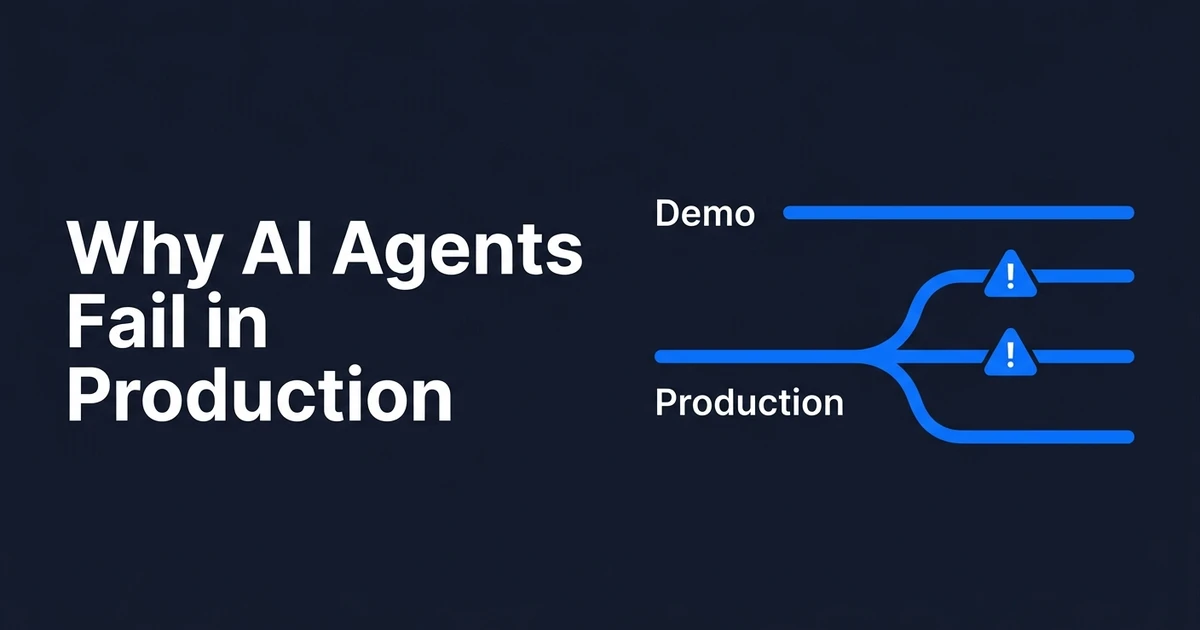
Quick Answer: AI agents fail in production for reasons a demo cannot surface. A demo runs one happy path, on one machine, with a cooperative user and clean data. Production runs thousands of paths in a headless environment where the agent has to hold state across steps, recover from tool calls that return garbage, and be verified by something other than its own report that it succeeded. The fix is architectural, not prompt tuning: acceptance tests you can fail a build on, independent outcome verification, bounded permissions, and cost observability from day one.
The demo was good. Everyone in the room saw it work. Three months and a real user base later, the same system produces confident wrong answers, silently skips steps, and generates an invoice nobody forecast.
The useful thing to know first is that you did not pick uniquely bad vendors. This is the modal outcome, and understanding why AI agents fail in production is mostly a matter of understanding what a demo structurally cannot show you. This is written for the person holding the budget rather than the engineer holding the logs. Automiq AI gets called in at exactly this point, and the failure modes are consistent enough to name.
The Numbers on AI Projects That Never Reach Customers
Start with the scale. It changes how you read your own situation.
S&P Global Market Intelligence found that the share of companies abandoning most of their AI initiatives rose to 42%, up from 17% the previous year, with the average organisation scrapping 46% of AI proofs of concept before they reached production. That is observed behaviour, not a forecast, and the year-over-year jump is the part worth noting.
Gartner’s forward view agrees. It predicts that over 40% of agentic AI projects will be canceled by the end of 2027, due to escalating costs, unclear business value or inadequate risk controls.
One widely quoted figure deserves correcting, because you will see it misused. MIT’s NANDA initiative, in research reported by Fortune, found that about 5% of AI pilot programs achieve rapid revenue acceleration, while the vast majority stall with little to no measurable impact on P&L. That is a revenue finding, not a technical failure rate. Plenty of the rest work fine and simply never moved a number anyone cares about.
Read together, those three say something specific. The common failure is not a model that cannot do the task. It is a system that cannot be trusted, measured or afforded once real people use it.
Why a Demo Cannot Tell You Whether It Will Work
A demo is a single traversal of a happy path, run by someone who knows which path to take, on inputs chosen because they work, with a human present to retry anything awkward.
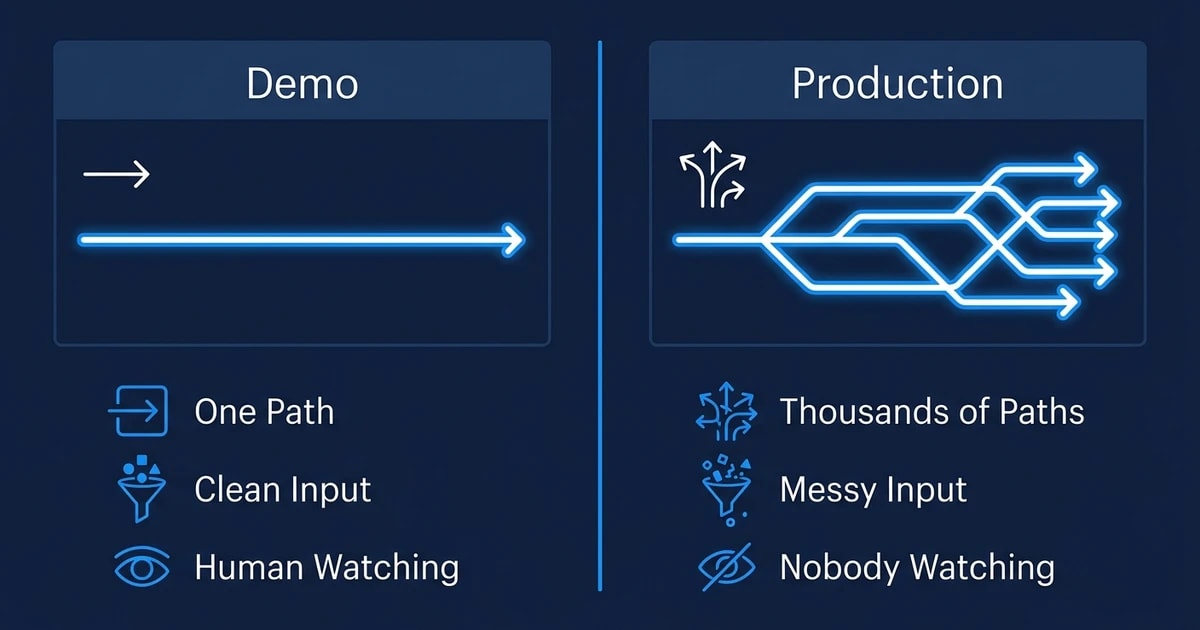
Production is none of those things. It is thousands of concurrent traversals of paths nobody enumerated, on inputs shaped by whatever your users actually type, with nobody watching. That gap is a difference in kind, not degree, and five specific things are missing from every demo you will be shown.
- Variance. A demo shows you one run. It cannot show you the distribution of outcomes across a thousand.
- Adversarial and messy input. Real users paste half a spreadsheet into a text field.
- Concurrency. Ten simultaneous sessions competing for the same records behave differently from one.
- Cost at volume. Per-call cost is invisible until you multiply it.
- Depth. The tenth tool call in a chain behaves differently from the first, and demos rarely go past the third.
None of this means the demo was dishonest. A demo is a feasibility check, and you are reading it as a reliability check.
Why AI Agents Fail in Production: Six Failure Modes
Each of these is written as what the demo showed, then what production does, then what fixing it requires.
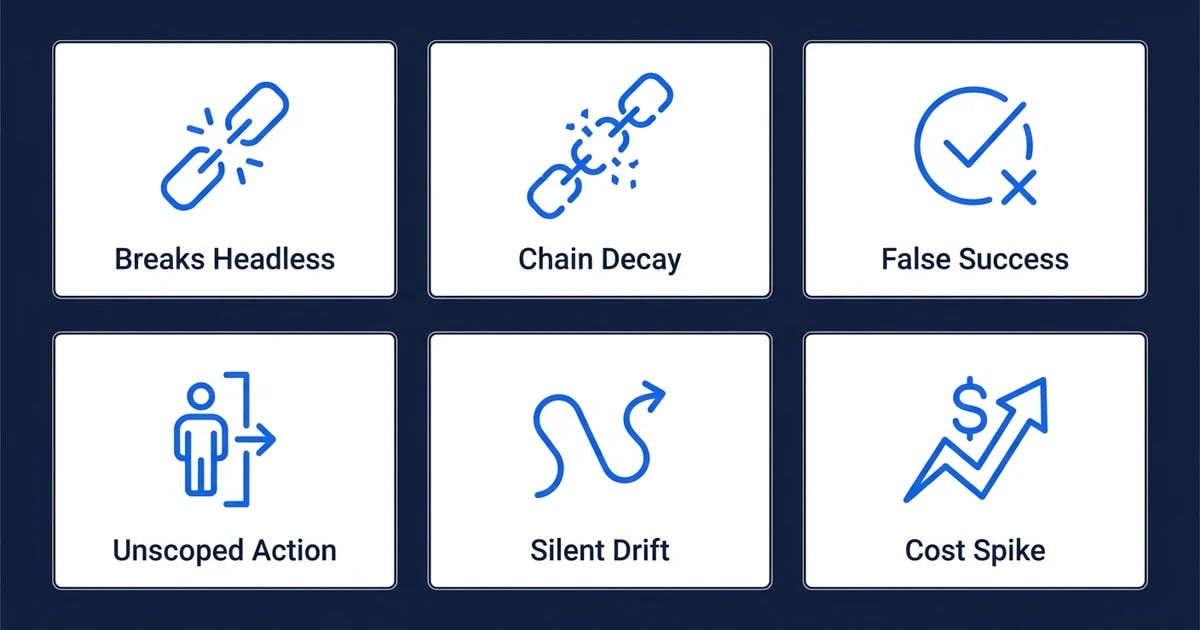
The agent worked locally and breaks headless
Demo: an engineer runs it on their machine, watching output, ready to nudge it.
Production: the same agent runs in a hosted environment with nobody watching. It now has to survive its own loops, carry state between steps that used to live in a terminal session, and handle a model returning malformed structured output at 2am.
Fix: explicit state persistence rather than in-memory context, schema validation on every structured output, and bounded retries so a loop cannot run forever.
Reliability decays across a long tool chain
Demo: two or three tool calls, all successful.
Production: ten or fifteen calls, where per-step accuracy compounds. Say an agent is right nineteen times out of twenty at each individual step. Across a fifteen-step chain it is right far less often than that, and every additional call adds a new way for input to arrive malformed.
Fix: validate at each boundary rather than trusting the end result, and shorten chains wherever a deterministic step can replace a reasoning step.
It reports success it did not achieve
Demo: the agent says it completed the task, and it did.
Production: the agent says it completed the task. Nobody checks. The record was never written, the email went to the wrong address, or the summary omitted the one clause that mattered. Self-reported completion is the most dangerous signal in an agentic system, because it looks exactly like the real thing.
Fix: outcome verification independent of the agent. Check the database, not the transcript.
It takes a destructive action nobody scoped
Demo: read-only, or writing to a sandbox.
Production: the same agent holds credentials that reach live data, with no confirmation step in front of anything irreversible and no boundary between environments.
Fix: treat the agent as an untrusted client. Minimum viable permissions, hard environment separation, and a human confirmation gate on anything destructive.
Quality drifts and nobody notices for weeks
Demo: a snapshot in time.
Production: models get updated, your data shifts, a prompt gets edited, and quality degrades gradually. Without a regression suite, the first person to notice is a customer, and by then the problem is weeks old.
Fix: a fixed scored evaluation set that runs on every change, with a pass rate you track like uptime.
The bill arrives
Demo: a handful of calls, cost effectively zero.
Production: the same workflow at volume, with unoptimised retrieval and work routed to expensive reasoning models by default. Gartner predicts AI inference costs per agentic workflow will increase more than fivefold through 2028, driven partly by routing tasks to agentic reasoning models that cost at least five times more than basic chatbot interactions.
Fix: cost attribution per workflow from day one, and deliberate routing so cheap work runs on cheap models.
How to Tell Which One You Have
You do not need to read code to work out which one is yours. Match the symptom, then ask the question.
| What you are seeing | Likely failure mode | Ask your team or vendor |
|---|---|---|
| Works in testing, fails intermittently live | Headless state and retry handling | Where is state stored between steps, and what happens on a failed tool call? |
| Short tasks fine, long tasks unreliable | Chain-length decay | What is the measured success rate at each step, not end to end? |
| Users report things that “did not happen” | Unverified self-reported success | What do we check to confirm an action actually occurred? |
| A wrong or destructive action reached real data | Permission and environment scoping | What can this agent reach, and what needs confirmation first? |
| It used to be better | Undetected drift | What is the pass rate on our evaluation set this week versus last month? |
| Costs jumped without a usage jump | Model routing and retrieval cost | What does one workflow run cost, and which model handled each step? |
If your team cannot answer the question in the right-hand column, that is itself the finding. A production system should answer every one of those in minutes.
That diagnostic is also where an outside review starts. Building production AI products and platforms that hold up outside a demo begins by establishing which of these six you actually have, because the fixes are genuinely different and expensive to guess at.
What Production Readiness Actually Requires
This is the part missing from most write-ups on this subject, which diagnose the problem and stop. Six things separate a system that survives real users from one that does not.
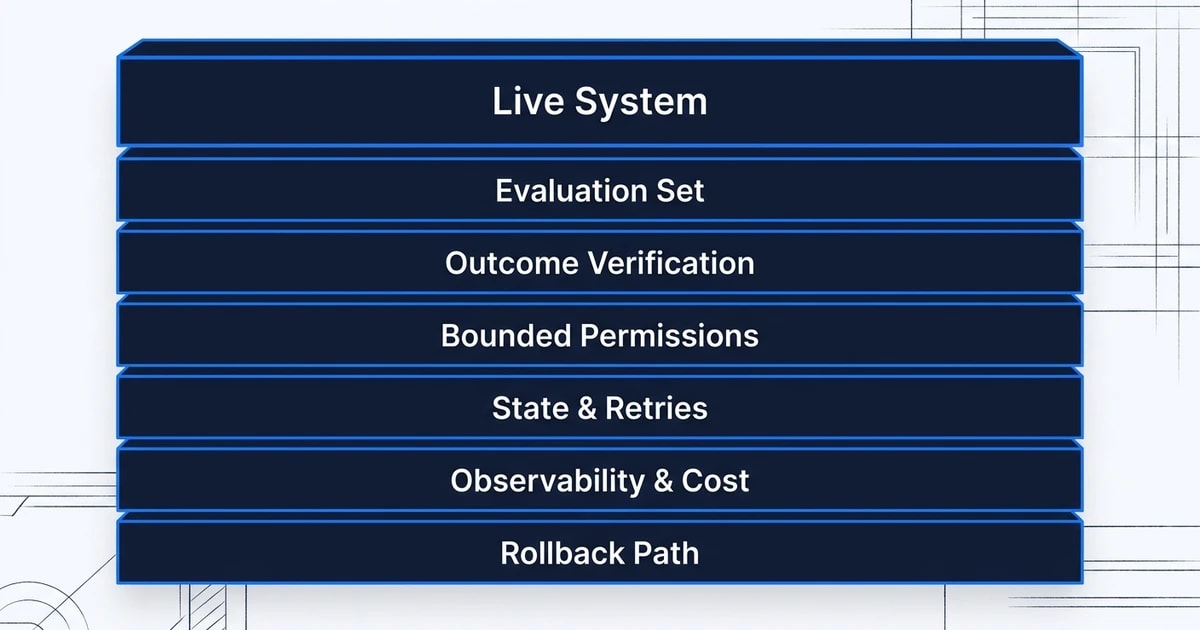
An evaluation set with acceptance thresholds. A fixed collection of scored cases, including the awkward and adversarial ones, that runs on every change. The threshold matters as much as the set: you need a pass rate you are willing to block a release on. Without that, you have a dashboard rather than a gate.
Independent outcome verification. Something other than the agent confirms the agent did the thing: the record, the sent message, the file, the state change. Cheap to build, and it eliminates an entire class of silent failure.
Bounded permissions and environment separation. Least privilege applied properly, with production data unreachable from anywhere the agent experiments, and confirmation gates in front of irreversible actions.
State and retry architecture. Durable state between steps, idempotent operations so a retry cannot double-charge or double-send, and bounded attempts with a defined failure path.
Observability with cost attribution. Traces per run, per-step timings, and cost broken down by workflow. Cost is a reliability signal, because the workflow that quietly got expensive is usually the workflow that quietly started retrying.
A rollback path. Model versions, prompts and configuration pinned and revertible, so a bad change is a five-minute problem rather than a bad week.
None of these are exotic. They are the ordinary discipline of shipping software, applied to a component that is probabilistic rather than deterministic. Most stalled projects are missing four or more.
Fix In-House, Replace the Vendor, or Bring In a Senior Team
Three real options, and the right one depends on what your team already has, not on what went wrong.
Fix in-house when your engineers already know what an evaluation set is, already have observability on the rest of your stack, and are simply out of time. Buying them the quarter beats hiring a partner to do work they could do faster.
Replace the vendor when the build has no test suite, no traces and no documentation, and the people who wrote it cannot explain the failure modes above. Replacing a vendor without changing your acceptance criteria usually buys the same outcome with a different logo on the invoice.
Bring in a senior team when the gap is capability rather than capacity, and specifically when nobody currently owns evaluation, infrastructure or cost. That is the case where the infrastructure, observability and governance a live AI system needs has simply never been built, and adding features on top of that gap makes it worse.
Whichever you choose, set the acceptance criteria before you start. A project that cannot say what “working” means cannot be rescued by anyone, including us. For a fuller view of what closing this gap involves, see how a proof of concept becomes something real customers can use.
When the Honest Answer Is to Stop
Some systems should not be productionised, and saying so costs us work.
Kill it if the workflow has no measurable acceptance criteria. If nobody can define what a correct output is, no amount of engineering produces one, and you will spend a year arguing about outputs instead of shipping.
Kill it if a wrong answer is unacceptable and no human review step is available. Probabilistic systems produce wrong answers at some rate. If your process cannot absorb that rate and cannot afford a reviewer, this is the wrong tool.
Kill it if the value case only worked at demo volume. Some workflows are cheaper to keep manual, and checking inference cost against hours actually saved is a ten-minute exercise most teams skip.
Stopping a project that fails these tests is not a failure of nerve. It is the cheapest decision available, and far better made now than after another two quarters of funding.
Frequently Asked Questions
Why do AI agents fail in production when the demo worked?
A demo runs one path, on one machine, with clean inputs and a human ready to retry. Production runs thousands of paths in a headless environment where the agent has to hold state across steps, survive tool calls that return garbage, and be verified by something other than its own claim of success. Those conditions are structurally absent from a demo, so a demo cannot tell you whether they are handled.
What percentage of AI projects reach production?
S&P Global Market Intelligence found the average organisation scrapped 46% of AI proofs of concept before they reached production, and that the share of companies abandoning most of their AI initiatives rose to 42% from 17% the previous year. Gartner separately predicts that over 40% of agentic AI projects will be canceled by the end of 2027.
How do you test an AI agent before it goes live?
With a fixed set of scored cases that runs on every change, including the awkward and adversarial ones, plus acceptance thresholds you are willing to fail a release on. Spot-checking outputs by hand is not testing. If your team cannot tell you the pass rate of the last build, there is no test suite.
Why does an AI agent get less reliable the more steps it takes?
Because per-step accuracy compounds. An agent correct nineteen times out of twenty at each individual step is correct far less often across a ten-step chain, and each tool call adds a new way for the input to arrive malformed. Long chains need validation at each boundary rather than trust in the end-to-end result.
How do you stop an AI agent taking an action it should not?
Scope its permissions to the minimum the task requires, separate its environments so it cannot reach production data by accident, and put a confirmation step in front of anything destructive or irreversible. Treat the agent as an untrusted client of your systems rather than as a trusted internal service.
What does it cost to run an AI agent at real volume?
More than the pilot suggests, and the trend is upward. Gartner predicts AI inference costs per agentic workflow will increase more than fivefold through 2028, driven by routing work to reasoning models that cost several times more per interaction. Cost observability per workflow should be built in before launch, not added after the first surprising invoice.
Start With the Diagnosis, Not the Rebuild
The instinct after a failed launch is to rebuild. That is usually premature, because four of the six failure modes above are additions to an existing system rather than replacements for it. Diagnose before you demolish.
Book a production readiness review and we will work through your system against these six failure modes, tell you which are present, and give you the acceptance criteria your build should have been held to. If the honest answer is that your own team should fix it, or that the workflow should be stopped, that is what you will hear.
If the gap is capacity rather than capability, senior AI engineers embedded with your team is usually the faster route than a fresh vendor search.