Quick Answer: Most teams who think they have outgrown no-code have actually outgrown the way their app was built on it. The genuine signals are structural: your data model exists to work around the platform, permissions have become unmodellable, platform cost is scaling faster than revenue, and you cannot hire anyone willing to work in it. Slow screens, a messy build and a scary bill are usually fixable in place, and rebuilding for those reasons alone is the most expensive mistake in this decision.
Before you read anything about the signs you’ve outgrown no-code, including this, notice who wrote it. Pages telling you the platform is fine are usually published by agencies that build on it. Pages telling you to rebuild are published by firms that sell rebuilds.
Automiq AI does both. We migrate apps off platforms and we optimise apps that stay on them, which is the only reason this article can end with four reasons not to move.
Most Teams Who Think They’ve Outgrown No-Code Haven’t
Being on a platform is not a confession. Forrester found 87% of enterprise developers use low-code development platforms for at least some of their development work. Nothing about your situation requires an apology.
What usually happens is subtler. Someone builds fast, learns the product in public, and accumulates a build shaped by six pivots. Two years later the app is slow, the bill is uncomfortable and nobody enjoys touching it. That feels identical to hitting a ceiling, and it is not the same thing.
Here is the distinction this article turns on. A platform constraint is something no amount of skill can build around. A build constraint is something a good engineer could fix on the platform you already pay for. Only the first is a reason to leave.
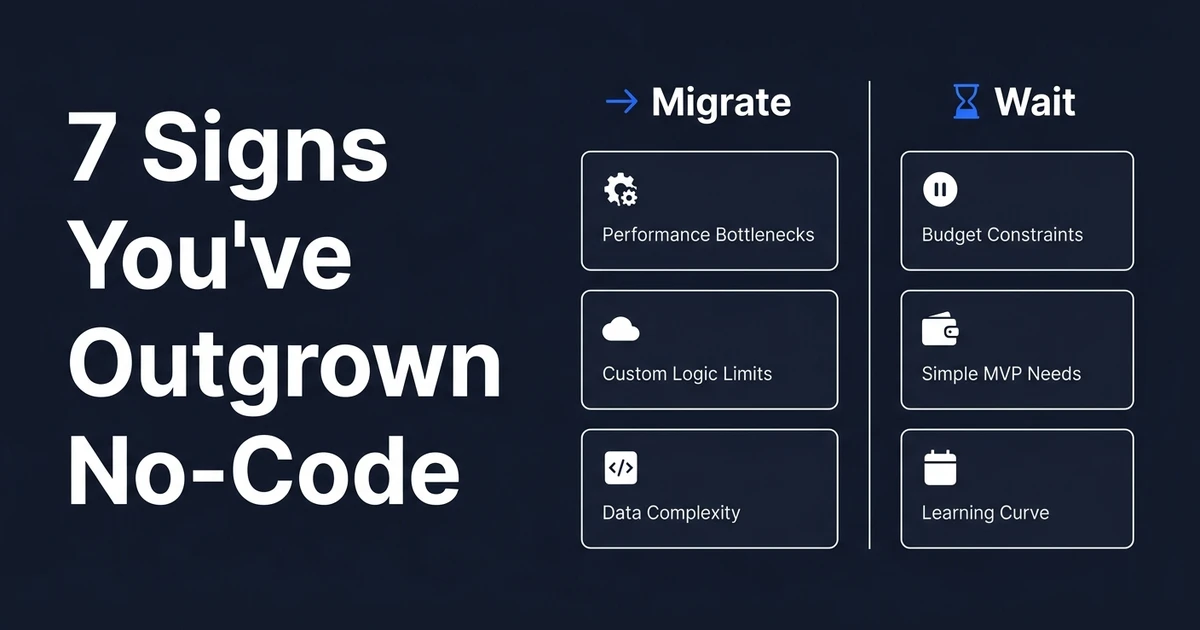
The 7 Signs You’ve Outgrown No-Code
Each is written as a condition you can test rather than a feeling you can have. If you cannot check it against something concrete in your app, it is not firing.
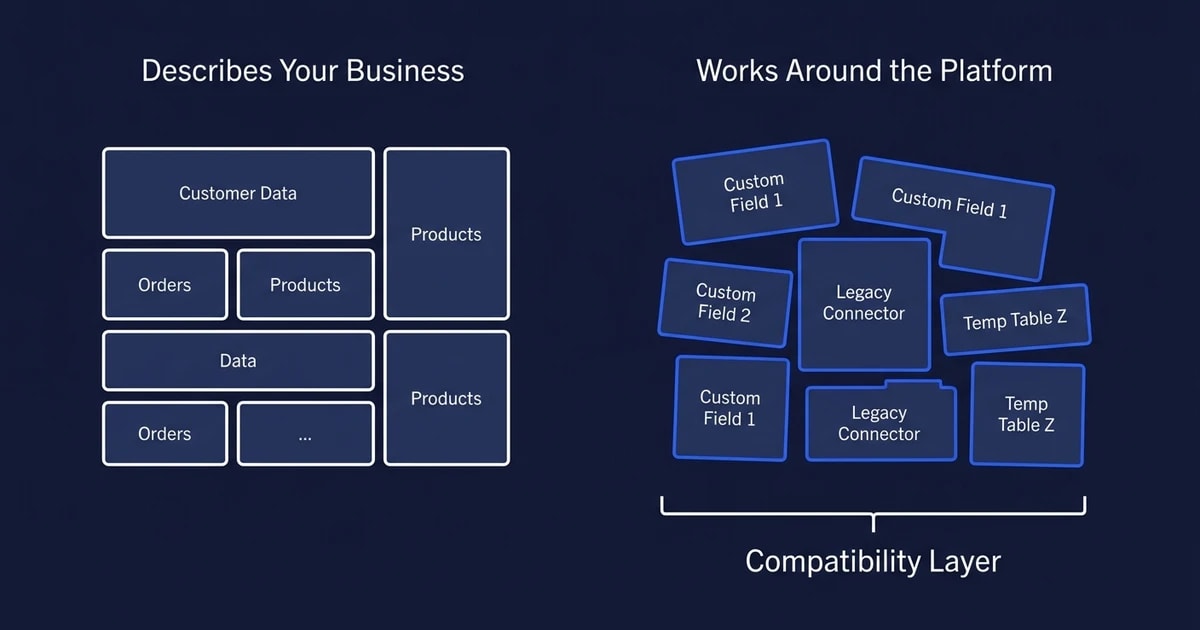
Your data model exists to work around the platform, not to describe your business
Sort your tables into two piles. One exists because you have customers, orders and invoices. The other exists because a privacy rule forced a duplicate field, a list could not do a join, or a workflow needed a staging table.
When the second pile approaches the size of the first, you are running a compatibility layer with your business data inside it. Ignoring this costs you every future feature, because each is built against a schema that lies about your domain.
Permissions have outgrown what the platform can express
Users and admins are easy anywhere. Organisations containing teams containing users, with per-record sharing, delegated admin rights and impersonation, are not.
The test: did your last permission change need a workaround rather than a setting? If access rules live partly in the platform and partly in conditionals scattered through your workflows, that is a structural limit. Ignoring this produces the incident where the wrong customer sees the wrong record.
Platform cost is growing faster than revenue
Track your platform bill as a percentage of revenue across four quarters. Flat or falling means the platform scales with you and pricing is not your problem.
Rising means your unit economics degrade with every customer you add, which is the opposite of what software should do. Note the diagnosis: it is the trend, not the absolute number. A large bill shrinking as a share of revenue is a good bill. Ignoring this means growth quietly making you less profitable.
You cannot hire anyone willing to work in it
You have tried to hire across several attempts and either found nobody, or found people whose work you could not evaluate. Meanwhile one person is the only human who can safely change anything.
This is the most underrated signal here because it presents as a staffing annoyance rather than a technical problem. It is a business risk. Ignoring this caps your roadmap at one person’s calendar and, eventually, their notice period.
Developer frustration alone is not the signal. In Stack Overflow’s survey, 62.4% of developers named the amount of technical debt as their top frustration, roughly double the next issue. Everyone is frustrated. Being unable to hire at all is different.
A single customer requirement is now unbuildable
Somebody asked for something reasonable, an audit log, a bulk operation, an SSO login, a compliance control, and the honest answer was that the platform cannot do it.
One unbuildable request is a data point. A pattern of them, especially from the customers you most want, means the platform is choosing your roadmap. Ignoring this loses deals for reasons you cannot explain to the prospect.
You cannot get your data out in a usable shape
Export your core tables and see what arrives. Check whether relationships survive, whether history comes with them, and whether a database could accept the format without a translation project.
If you get a flat file with references you cannot resolve, your exit cost rises every month you keep adding data. Ignoring this makes every future decision more expensive than the same one made today.
Debugging has become most of the team’s week
Look at where your technical time went last month. If most of it went to keeping the thing working rather than making it do more, you are paying maintenance without buying progress.
Everyone has bad months. A full quarter is a trend. Ignoring this pays a team to stand still.
Recognise several of these? What a phased migration off a no-code platform involves is worth understanding first. The phased version is usually cheaper and always less risky than the all-at-once version people imagine.
4 Signs That Say Fix It First
These four are the most common reasons founders decide to migrate, and all four are usually wrong. Read them as flatly as written.
The app is slow in three specific places
Not slow generally. Slow on the dashboard, the search page and one report. That is a query problem, and those have fixes measured in days.
Rebuilding an application to fix three screens is the most expensive way to solve something an engineer could profile in an afternoon.
The bill is high because of one unoptimised process
A scheduled job scanning everything, a workflow re-running on every save, a search hitting the database harder than it needs to. One process is frequently responsible for most of a surprising bill.
Find the process before you find a vendor. If the bill drops back into a sane range once it is fixed, you never had a platform cost problem.
The build is messy but the model is sound
Duplicated logic, inconsistent naming, workflows nobody has pruned in two years. Unpleasant to work in, and completely fixable in place.
Messy is cheap to fix. A wrong data model is expensive to fix. Mistaking the first for the second is how a two-week cleanup becomes a six-month project.
You are pre-product-market-fit and still changing the product weekly
If the product is still moving, the platform’s speed is worth more than custom code’s elegance. Rebuilding a moving target means paying to re-implement decisions you are about to reverse.
There is a blunt statistical case for waiting. Gartner found that only 48% of digital initiatives meet or exceed business outcome targets, from a survey of more than 3,100 CIOs and technology executives across 88 countries. Trading a working system for a coin flip needs a better reason than dissatisfaction.
In all four, a rebuild converts a fixable problem into a six-month one. Fix the thing in front of you and re-run this list in two quarters.
The Test That Separates Them
One question resolves most cases. Could a competent engineer rebuild the same functionality on the same platform, and would the problem disappear?
If yes, your constraint is the build. Migrating will not fix it, and you will find that out after paying, because the decisions that produced a messy platform app produce a messy custom one.
If no, because the platform cannot express your permissions, your data relationships or your compliance requirements, the constraint is structural and no amount of skill removes it. That is what a migration is for.
Most teams have not asked this before they start collecting quotes. Ask it first. It is free.
A Decision Tree You Can Run in Ten Minutes
Work through these in order. Stop at the first match.
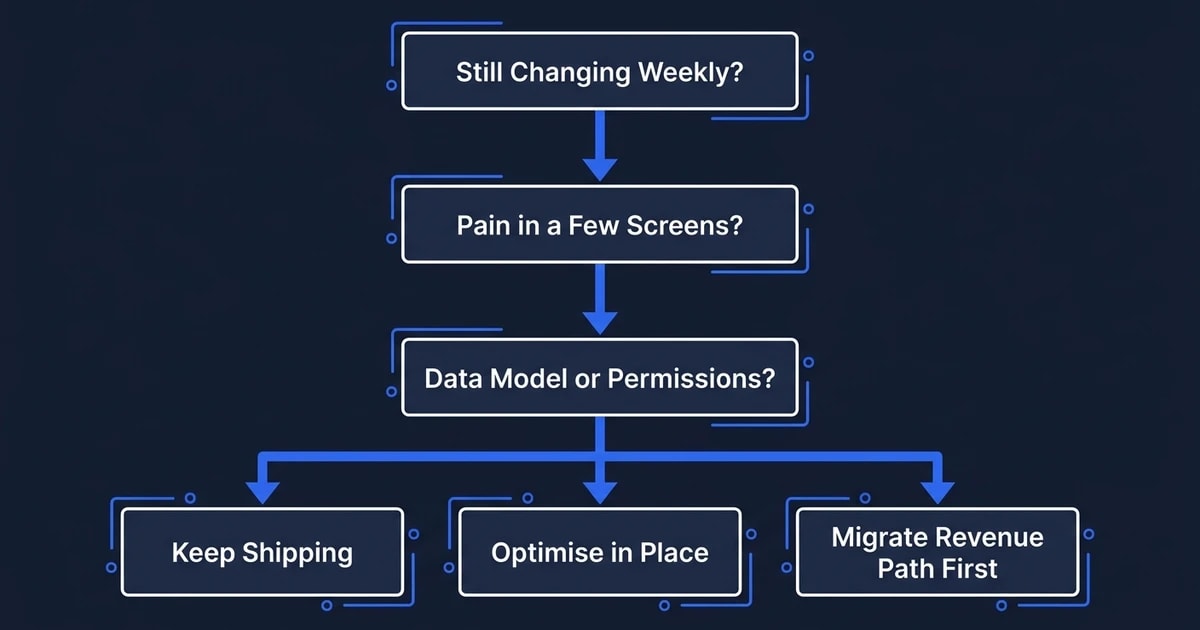
- Are you still changing the product weekly? Stay and keep shipping. Re-run this in two quarters.
- Is the pain concentrated in specific screens or one process? Optimise in place. Profile it before you price anything.
- Is your data model mostly workarounds, or can the platform not express your permissions? Migrate. This is structural.
- Can you not hire for the platform, and is one person the only one who can change it? Migrate, and treat it as risk reduction rather than a feature project.
- None of the above, but the bill trend is rising against revenue? Investigate for one quarter first, then decide with data rather than with the invoice.
- Migrating? Move the revenue-critical path first, not everything at once.
Notice how many paths end somewhere other than a rebuild. That is not an accident of the drawing. It reflects what happens when these apps get looked at properly.
What Happens to Your Users If You Do Migrate
Two questions come up first every time, and both deserve straight answers before you commit.
Do users have to reset their passwords? Usually yes. Most platforms store password hashes you cannot export in a reusable form, so accounts need a reset flow rather than a silent transfer. Profile data, roles and history normally move cleanly. Plan the reset as a product decision with a communications plan, because your users will notice it.
Does history survive? It can, but it has to be in scope. Historical records are separate work from current state, and the line item most often quietly dropped from a quote. Decide whether you need three years or ninety days before anyone prices the job.
Both have cost implications. What a rebuild actually costs and why quotes vary so widely covers how they show up in a proposal.
Frequently Asked Questions
What are the signs you’ve outgrown no-code?
The genuine signals are structural rather than cosmetic: your data model exists to work around the platform, your permission requirements cannot be expressed in it, platform cost is growing faster than revenue, you cannot hire anyone willing to work in it, a customer requirement has become unbuildable, or your data will not come out in a usable shape. Slow screens and a messy build are not on that list.
How do I know if the problem is the platform or how my app was built?
Ask whether a competent engineer could rebuild the same thing on the same platform and make the problem disappear. If yes, your constraint is the build and a migration will not fix it. If no, because the platform genuinely cannot express what you need, the constraint is structural and a rebuild is on the table.
Is it worth rebuilding a no-code app before product-market fit?
Almost never. Rebuilding a product you are still changing weekly means paying to re-implement decisions you are about to reverse. The speed of the platform is worth more than the elegance of custom code while the product is still moving. Stabilise what works, then rebuild what survived.
What if nobody will work on my no-code app any more?
That is one of the strongest migration signals there is, and it worsens over time. A system only one person can safely change is a business risk regardless of how well it runs. If you have been unable to hire across several attempts, treat it as structural and plan accordingly.
Do I have to rebuild everything at once?
No, and you usually should not. Moving the revenue-critical path first lets you prove the new stack against real traffic while the rest of the app keeps running where it is. It costs more coordination than a single switchover but far less risk, and it gives you a real exit point if priorities change.
Get a Second Opinion Before You Commit
The expensive version of this decision is making it from frustration. The cheap version is spending an hour establishing whether your constraint sits in the platform or in the build. Those answers lead to projects that differ by an order of magnitude in cost and risk.
Book a scoping call and we will give you that read on your actual app, from a team with no incentive to push either answer. If the honest call is to optimise what you have and revisit in six months, that is what you will hear.
No in-house engineering lead to sanity-check it? A technical partner for founders without one is worth understanding before you hire for the problem.