Quick Answer: Published quotes to migrate an app off no-code run from roughly $8,000 to $150,000, and the spread is not vendor greed. It is driven by five things: how many of your workflows are load-bearing rather than merely present, whether your data model describes your business or works around the platform, how complex your permissions and auth are, how many integrations must survive the move, and whether your users can tolerate a hard cutover. Price the migration by those five, not by screen count.
If you have asked three firms what a no-code migration cost looks like for your app, you have probably received three numbers that do not resemble each other. One came back at $12,000. One came back at $45,000. One asked for a discovery engagement before quoting anything at all.
That range is real, and it is not evidence that two of them are overcharging you. They are pricing three different projects and none of them said which one.
This is a breakdown of what actually moves the number, so you can price your own app before anyone quotes it. Automiq AI builds both ways, so we have no structural reason to push you toward a rebuild, and we will get to the case for not doing one at all.
Why No-Code Migration Cost Quotes Range by 10x
Start with the shape of the market you are buying in. Being on a no-code platform is not a niche mistake you need to feel embarrassed about. Forrester found that 87% of enterprise developers use low-code development platforms for at least some of their development work, with the market growing from $13.2 billion in 2023 toward roughly $30 billion by 2028 in Forrester’s base case.
So the question is not whether the platform was a mistake. It is what the next version costs, and why nobody agrees on that number.
Here is the honest answer. Most quotes are priced off surface area, because surface area is the only thing a vendor can count in an hour. Screens, pages, tables, roles. It is a weak predictor of effort.
What predicts effort is how much of your app is load-bearing, how much of your data model is real, and what happens to your users on switchover day. None of that is visible from a screen-share, which is why quotes based on one are unreliable.
It also helps to reframe what you are buying. A migration is not new spend on a new product. It is repayment of technical debt, and that debt is normal. McKinsey found that technical debt accounts for about 40 percent of IT balance sheets, and that 30 percent of CIOs believe more than 20 percent of their technical budget nominally dedicated to new products is diverted into resolving it.
The Five Things That Actually Set the Price
These five drivers explain almost all of the variance between quotes. Work through them on your own app and you can predict roughly where a serious vendor will land before they open their mouth.
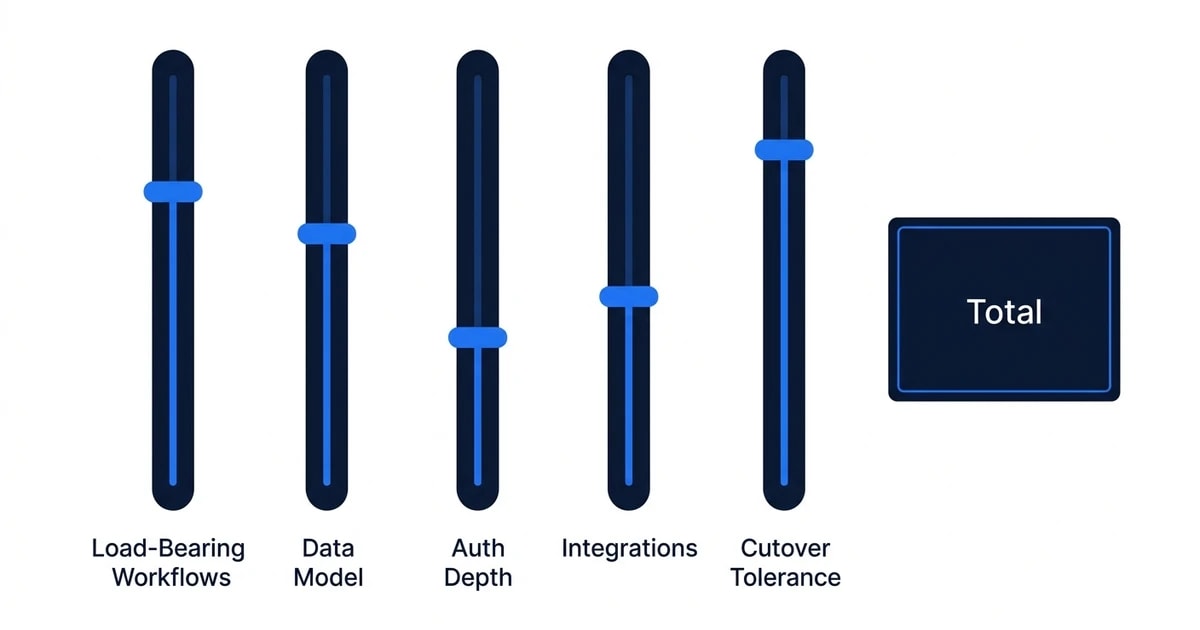
Two are usually underestimated by a wide margin, and one is routinely left out of quotes entirely. Both are flagged below.
Load-bearing workflows vs total workflows
Your editor will tell you that you have, say, 34 workflows. That number is nearly useless for pricing.
What matters is how many carry revenue, carry a compliance obligation, or would generate a support ticket within an hour of breaking. In most apps it is between four and ten. The rest are convenience features, admin shortcuts and things nobody has run since.
A vendor pricing all 34 at equal weight produces a number that is too high, and quietly punishes you for having experimented. A vendor who asked which ones are load-bearing is pricing the actual system. Ask every quote to split those two groups.
Whether your data model describes your business
The single largest cost driver, and the one buyers almost never check.
Open your database and look at your tables. Some exist because your business has customers, orders and invoices. Others exist because privacy rules forced you to duplicate a field, a list view could not do a join, or a workflow needed a staging table to work around a limitation.
The first kind moves across almost mechanically. The second kind has to be untangled before anything can be rebuilt, because nobody can write correct code against a schema whose shape is an accident of tooling. If half your tables are in the second category, your migration is a data modelling project with a build attached, and it will be priced accordingly.
Auth, roles and permission depth
Underestimated almost universally. A quote that treats login as a checkbox was written by someone who has not done this.
Two apps with identical screens can differ by weeks. One has users and admins. The other has organisations containing teams containing users, with per-record sharing, an invitation flow, delegated admin rights and an undocumented support-impersonation mode.
The second one also has a second problem: most no-code platforms store password hashes you cannot export in a usable form, so existing users will need a reset flow rather than a silent transfer. That is a product decision with churn implications, not a technical footnote, and it belongs in the quote.
Integration count and who owns each contract
Count every external system your app talks to. Payments, email, e-signature, accounting, calendars, your CRM, whatever webhook someone wired up during a launch push.
Each is a contract you now honour in a different language. Where the platform gave you a connector, you are rebuilding it. Where an integration is inbound, a third party is pointing at a URL that has to keep working.
The cost is rarely in any single integration. It is in the total count, and in how many nobody currently owns.
Cutover tolerance
Left out of quotes more often than any other item on this list, and frequently the difference between two otherwise similar numbers.
One question: can your users lose access for a weekend? If yes, you are buying a hard cutover, and it is dramatically cheaper. If no, you are buying a period where both systems run against one source of truth, with sync, reconciliation and a rollback plan.
Parallel running is not a premium option added to inflate the bill. It is a harder engineering problem, and pretending otherwise is how migrations go over budget in month three.
Not sure which of these five is driving your own number? Migrating a no-code application to custom software in phases starts with exactly this assessment, so you know what you are buying before anyone builds anything.
What a Migration Quote Should Itemise
Use this as a checklist against any proposal you receive, including ours. If a line item is missing, it has not been priced, which means it will either surface as a change request or be quietly skipped.
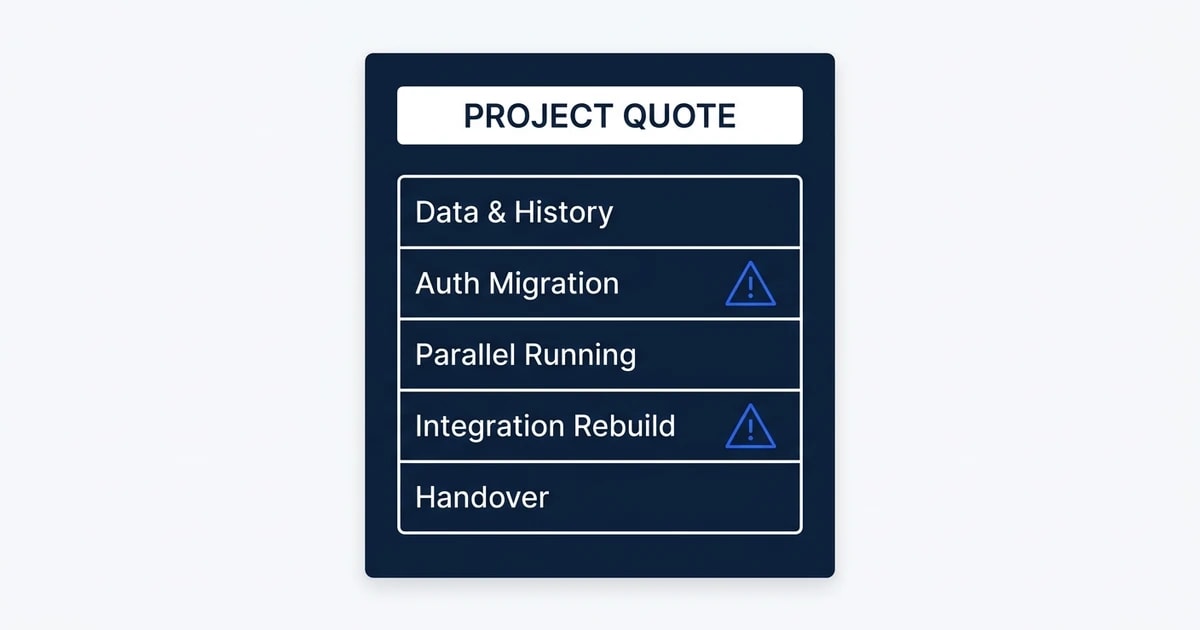
| Line item | What it covers | What a vague quote hides |
|---|---|---|
| Data and historical record migration | Moving live records plus history, with mapping for anything shaped by platform constraints | Whether history moves at all, or only current state |
| Auth and password migration | Account transfer, role mapping, reset flow, invitation and impersonation paths | That your users will be asked to reset passwords on launch day |
| Parallel running | Both systems live against one source of truth, with sync and reconciliation | That “cutover” meant a weekend of downtime nobody agreed to |
| Integration rebuild | Every outbound and inbound connection re-implemented and re-tested | Which integrations are in scope and who coordinates the inbound ones |
| Handover and documentation | Repository access, environment setup, architecture notes, operating knowledge | That you receive code you cannot deploy without the vendor |
The last row deserves attention. A migration that leaves you unable to run your own system has moved your dependency rather than removed it, which was probably the point of starting.
A Worked Example: Pricing the Same App Three Ways
Take a realistic case. A B2B client portal built on a no-code platform: around 40 screens, 12 workflows of which 6 are load-bearing, 3 integrations, 4,000 active users, three years of history, and a permission model with organisations and per-record sharing.
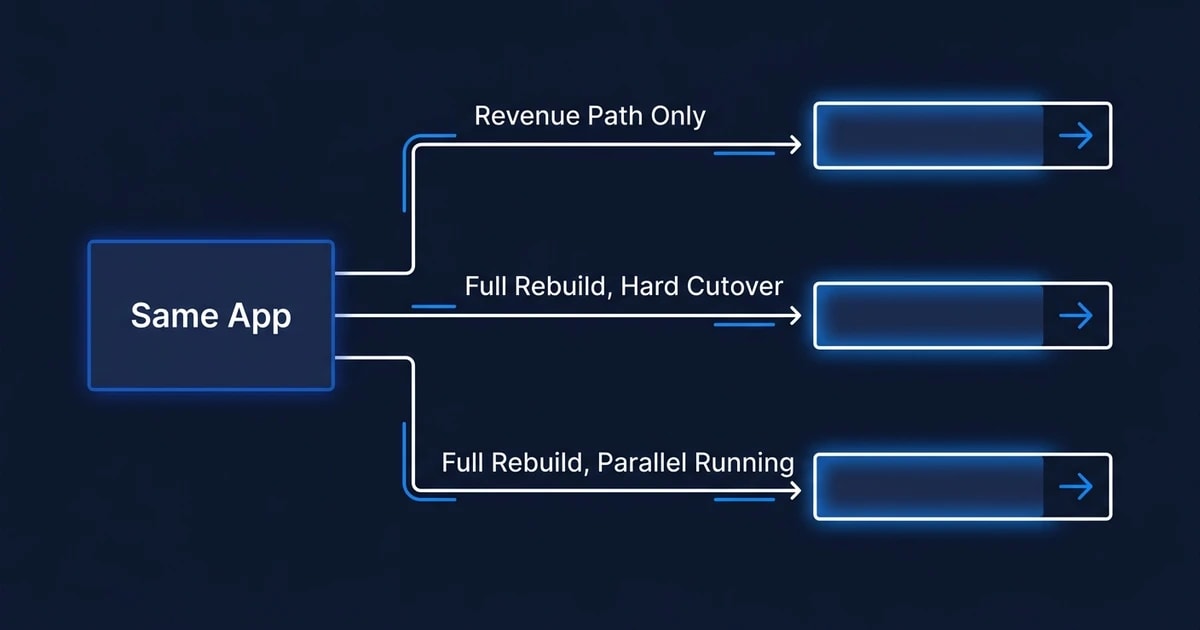
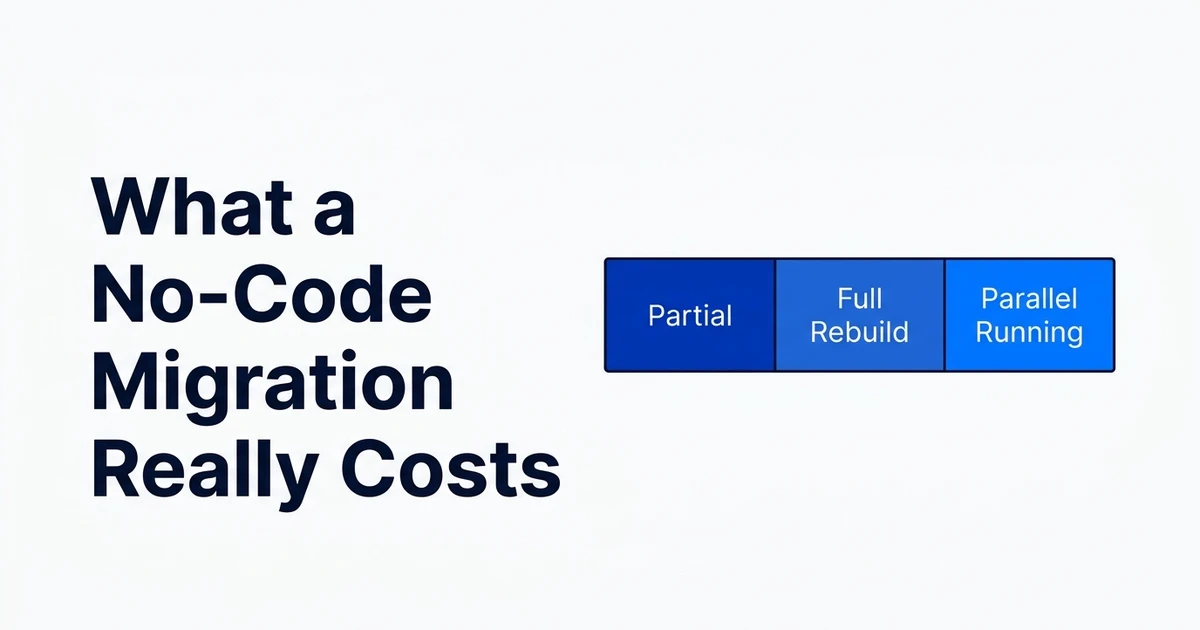
Here is how the same app lands in three different bands depending only on scope decisions you control.
Option one: migrate the revenue-critical path. Rebuild the 6 load-bearing workflows, the data they touch and the auth model. Everything else stays on the platform for now, reading from the new database. Shortest timeline, lowest number, and you validate the new stack against real traffic before committing further. The cost is a deliberate period of split ownership.
Option two: full rebuild, hard cutover. All 12 workflows, all screens, one switchover weekend. Meaningfully more expensive than option one because you are rebuilding features that generate no revenue, but you avoid the hardest engineering problem in this list. Viable for internal tools and B2B apps with predictable usage hours.
Option three: full rebuild, parallel running. Same scope as option two plus dual-write, reconciliation, a rollback path and a phased user migration. This is the top of the published range, and the increment over option two is almost entirely cutover engineering rather than features.
Same app, same team, three numbers that differ by a factor of four, decided before a line of code is written. When you compare quotes, confirm you are comparing the same option.
The Costs Nobody Puts in the Quote
Four costs sit outside the vendor’s scope and inside your budget. They are the usual source of the gap between the quoted number and what the project actually cost you.
- Parallel platform subscriptions. You keep paying the old platform throughout the build and any overlap period. On a full rebuild with parallel running, that is most of a year.
- Your own specification time. Someone on your team has to explain what the app does to developers who have never used the platform. If nobody in-house can read the existing logic, this becomes the longest pole in the project.
- Support during the overlap. Two systems means two places a bug can live and two places your team has to look.
- The rollback plan. You hope not to use it. You still pay for it, and a vendor who has not mentioned it has not planned one.
None of these are hidden fees. They are simply outside the boundary of what a build quote covers, and knowing that in advance is the difference between a project that lands on budget and one that does not.
When Rebuilding Is the Wrong Call
This section costs us work, and it is the most important one here.
If your platform bill is a small share of revenue, your data model still describes your business rather than working around the tooling, and your pain is concentrated in two or three slow screens, you do not have a migration problem. You have an optimisation problem, and it is usually solvable in weeks for a fraction of any number in this article.
The same is true if you are still changing your product weekly. Rebuilding a moving target means paying to re-implement decisions you are about to reverse. Get the product stable first, then rebuild what survived.
Be especially careful about rebuilding because the existing build is messy. Messy is cheap to fix. A wrong data model is expensive to fix. Those are different diagnoses with different price tags, and the honest test is simple: if a competent engineer could rebuild the same thing on the same platform and the problem would disappear, the platform is not your constraint.
Frustration on its own is also a weak signal, because it is close to universal. In Stack Overflow’s developer survey, 62.4% of developers named the amount of technical debt as their top frustration, roughly double the next issue on the list. Every team working on a system that ships is annoyed by that system. Annoyance is not a migration trigger, and a rebuild is itself a project that can fail.
How to Compare Two Migration Quotes
Run every proposal through these five questions. They take ten minutes and they will tell you more than the totals will.
- Which workflows did you price as load-bearing? If the answer is “all of them”, the vendor counted rather than diagnosed.
- What is the cutover strategy? Hard switch or parallel running. If this is not stated, the quote is not comparable to any other quote.
- Is historical data in scope? Three years of records is a different project from current state only.
- What happens to existing users on launch day? A vendor who has not raised the password question has not thought about your users.
- What exactly transfers at handover? Repositories, environments, infrastructure access, documentation and operating knowledge, or just a zip of code.
A vendor who answers all five without hedging is quoting your actual project. A vendor who cannot is quoting a guess, and the difference will surface in month two either way.
Frequently Asked Questions
How much does it cost to migrate a no-code app to custom code?
Public quotes from development firms run from roughly $8,000 for a simple app to $150,000 for a full rebuild of a complex one. The number depends far less on how many screens you have than on how many of your workflows carry revenue, how much of your data model exists to satisfy platform constraints, and whether your users can tolerate downtime during the switch.
Why does no-code migration cost vary so much between vendors?
Because most quotes price different scopes without saying so. One vendor is pricing a rebuild of your revenue-critical path with a weekend cutover, another is pricing every screen you have plus historical data migration and a month of parallel running. Ask both to itemise cutover strategy, data scope and handover before you compare the totals.
Can I migrate part of my app instead of rebuilding all of it?
Usually yes, and it is often the right call. Moving the revenue-critical path first lets you validate the new stack against real traffic while the rest of the app keeps running where it is. The tradeoff is a period where two systems share one dataset, which needs deliberate design rather than improvisation.
What happens to my existing users and their passwords during a migration?
Most no-code platforms store password hashes you cannot export in a reusable form, so users typically need a reset flow rather than a silent transfer. Profile data, roles and history usually move cleanly. Budget this as its own line item, because a botched auth migration is the failure mode users actually notice.
How long does a no-code migration take?
Published timelines from development firms range from about four weeks for a narrow partial migration to five or six months for a full rebuild with parallel running. The single biggest driver is not build time, it is how long it takes to specify what the existing app does, especially when nobody on the team can read the platform’s logic.
Is it ever cheaper to stay on the platform and optimise?
Often. If your platform bill is a small share of revenue, your data model still describes your business, and the pain is concentrated in a few slow screens, optimising in place usually costs a fraction of a rebuild and takes weeks instead of months. Rebuilding for those reasons alone converts a fixable problem into a six-month project.
The Number You Should Be Asking For
Stop asking what a migration costs and start asking what your five drivers look like. Load-bearing workflow count, data model integrity, permission depth, integration count, cutover tolerance. Price those and the quotes stop looking random.
If you want that assessment done properly, book a scoping call and we will work through your app against those five drivers, then tell you which of the three options fits and whether optimising in place beats rebuilding. If it does, we will say so. You will also get a clear view of what building custom software your team can own and maintain involves at handover, so you know what you end up holding.
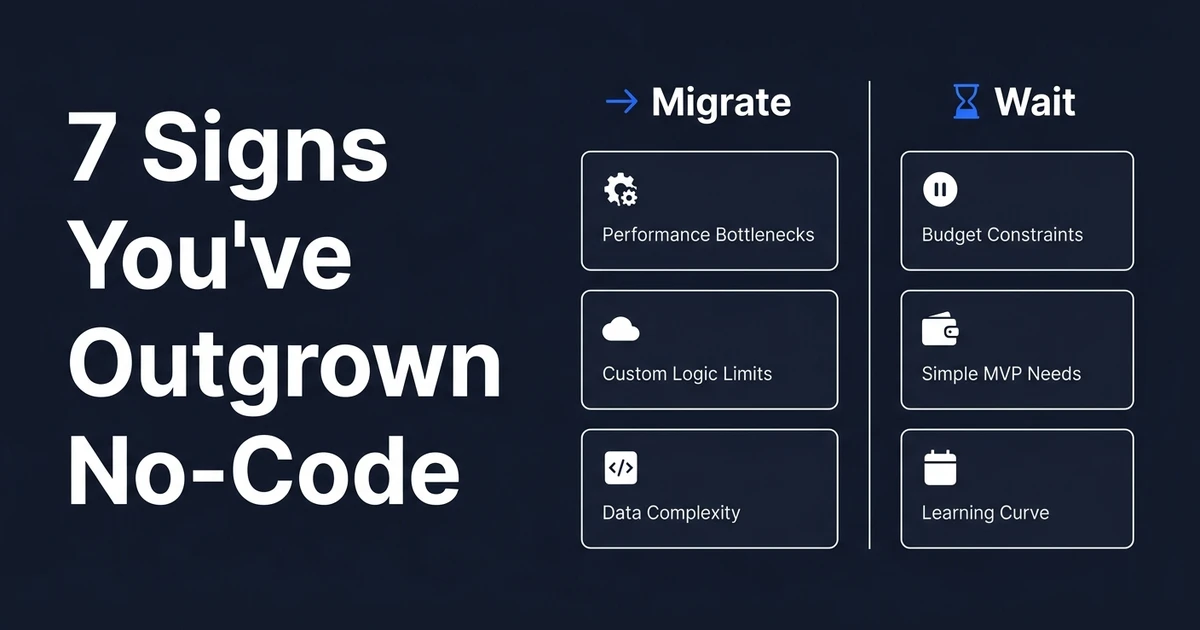
Still not sure the platform is your real constraint? Start with the signals that say you have actually outgrown it before you price anything.