EN
EN DE
DE ES
ES FR
FR NL
NL PT
PT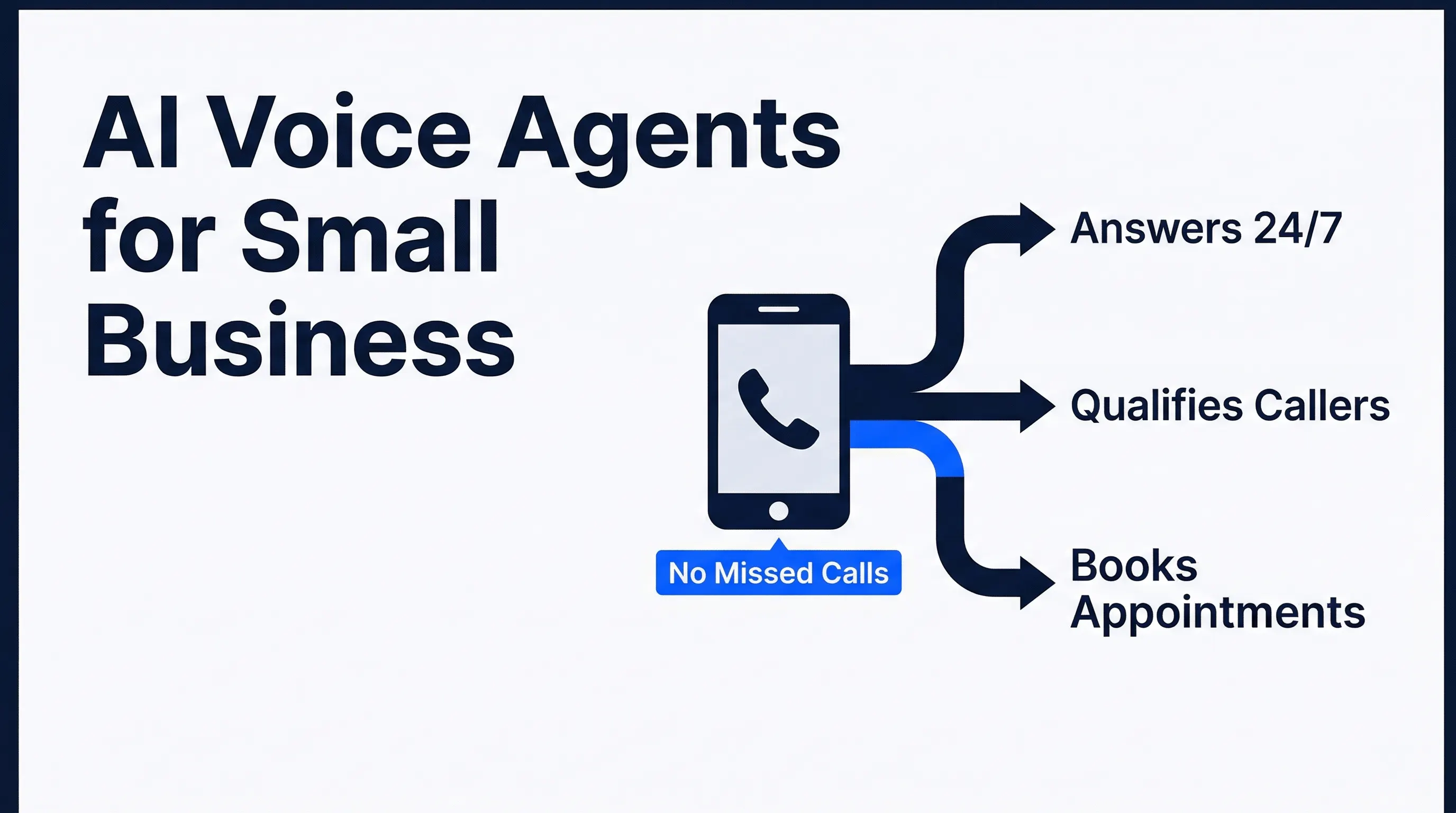
Quick Answer: An AI voice agent for small business is a phone system that answers calls 24/7, qualifies callers, and books appointments without any human involvement. For businesses losing leads to missed after-hours calls or spending staff time on screening, an AI voice agent typically recovers 10–20 hours per week in manual call handling.
Picture this: a real estate agent wraps up a long day of viewings at 7pm on a Friday. At 9pm, a buyer calls to ask about a property they saw online. Nobody answers. They leave a voicemail. By Monday morning, they’ve already booked a viewing with a competitor who picked up.
The agent didn’t lose that lead because of their service. They lost it because their phone line has a closing time and the buyer’s interest doesn’t.
An AI voice agent for small business solves this problem directly, without hiring anyone.
The Real Cost of a Missed Call
Most small businesses treat missed calls as an inconvenience. The research says they’re a revenue problem.
According to research published by Entrepreneur, 42% of small businesses estimate they lose at least $500 per month directly to missed calls. And data from Invoca’s call analytics platform found that 27% of inbound calls to service businesses go unanswered, with each missed call representing a measurable loss in booked revenue.
Small businesses are disproportionately exposed. You can’t afford a full-time receptionist for every shift. You’re often out on jobs, in client meetings, or simply unavailable after hours. Every missed call during those gaps is a lead that went unanswered at the exact moment they were ready to act.
The majority of callers don’t leave voicemails. They call the next business on the list.
What Is an AI Voice Agent?
An AI voice agent is software that answers your business phone, holds a real conversation with the caller, and takes action based on what they need.
This is not a phone tree. It’s not “press 1 for sales, press 2 for support.” An AI voice agent understands natural language. A caller can say “I’m looking to book an inspection for next week” and the system understands, checks availability, and books the appointment, all within the same call.
AI voice agents run 24/7, including evenings, weekends, and public holidays. They handle multiple calls at the same time. They don’t have off days, don’t put callers on hold while they look something up, and respond consistently every time.
They’re not a replacement for every human conversation your business needs. They’re purpose-built to handle the volume: the screening, booking, and information calls. Your team focuses on the interactions that actually require a person.
What AI Voice Agents Can Handle for Your Business
A well-configured AI voice agent handles the full range of routine inbound calls:
- Answering and qualifying callers: understanding their need, asking the right questions, and routing appropriately
- Booking and confirming appointments: connecting to your calendar and scheduling in real time, with automatic confirmation sent to the caller
- Answering common questions: your hours, pricing, services, location, and process, answered consistently every time
- Capturing lead details: name, contact number, and enquiry type, logged directly in your CRM without any manual step
- Escalating when needed: if a caller needs a human, the system transfers the call or sends a priority notification to your team
Here’s a concrete scenario: a plumbing business receives 40–60 calls per day. The majority are booking requests, availability checks, and questions about pricing. With an AI voice agent, those calls are handled automatically. The business owner only takes calls that require judgment: a complex job, a complaint, or a long-term commercial client.
That’s not a small shift. That’s a significant portion of the working day returned.
Which Types of Businesses Need an AI Voice Agent Most
An AI voice agent delivers the strongest return in businesses with these characteristics:
- High inbound call volume relative to available staff
- A primary conversion action that is appointment-based (consultation, inspection, booking)
- Enquiries that come in outside standard business hours
- Calls currently being handled by staff who could be doing higher-value work
That profile covers a wide range of service businesses. Law firms fielding intake calls from prospective clients. Real estate agencies receiving buyer enquiries after hours. Local trades and service businesses that get calls while the owner is on a job. Medical and wellness practices where appointment booking drives revenue.
If your phone is your main lead channel and you’re missing calls regularly, an AI voice agent addresses the problem directly. If your calls are mostly complex account management that needs human judgment, the case is weaker.
Explore AI automation solutions across industries to see how voice agents fit alongside other automation for your specific business type.
Automiq AI builds and deploys AI voice agents for small businesses, set up in 1–2 weeks inside your existing phone and calendar tools. See what’s included in each package.
AI Voice Agent vs Hiring a Receptionist: An Honest Comparison
The obvious alternative to an AI voice agent is a human receptionist. Here’s a straight comparison:
| AI Voice Agent | Full-Time Receptionist | |
|---|---|---|
| Availability | 24/7, including weekends and public holidays | Standard business hours only |
| Annual cost | One-time setup fee plus low monthly tool costs | $35,000–$50,000 salary plus benefits |
| Call capacity | Unlimited simultaneous calls | One call at a time |
| Consistency | Follows the same script every time | Varies by individual and day |
| Booking capability | Real-time calendar integration | Depends on system access and training |
| Complex enquiries | Escalates to a human | Handles in the moment |
| Setup time | 1–2 weeks | Weeks of hiring and onboarding |
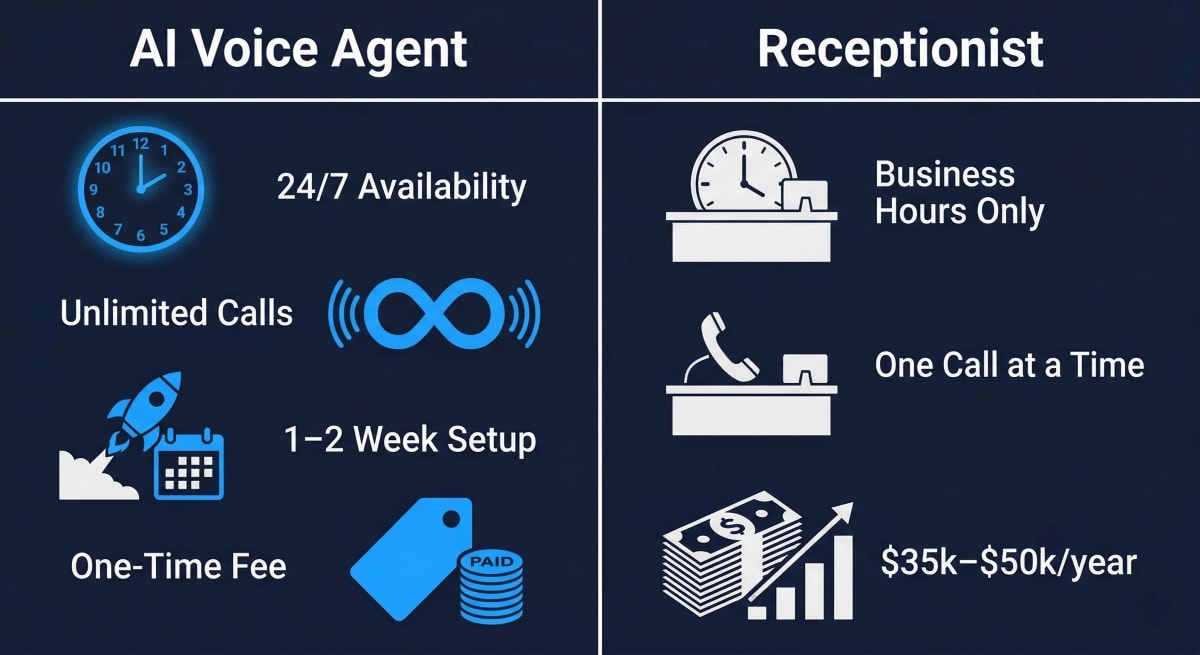
The comparison isn’t about which is “better” in absolute terms. It’s about what your business actually needs. For a business whose calls are mostly routine screening and booking, an AI voice agent covers the volume at a fraction of the cost. For a business where every call requires nuanced relationship management, a human is the right choice.
For most small service businesses, the reality sits in the middle: a mix of routine calls that AI handles and complex calls that get routed to a person. That’s exactly the setup a well-configured AI voice agent provides.
You can read more about how AI is reshaping the way small businesses operate in our overview of AI automation trends for small businesses.
What Implementation Looks Like
Deploying an AI voice agent does not require switching your phone system or changing your business number. In most setups:
- Your existing business number is connected to the AI voice agent layer
- The agent is configured with your call script, qualifying questions, and escalation rules
- Calendar and CRM integrations are connected and tested
- The system goes live and handles inbound calls from day one
A done-for-you build (including discovery, configuration, testing, and launch) typically takes 1–2 weeks. The scope of what gets configured, including call flows, booking logic, CRM logging, and escalation rules, is defined in the discovery call based on your specific requirements.
After launch, the system runs without technical oversight. If a call flow needs updating (a new service, a changed pricing question, a new team member to route to), those changes are handled as part of ongoing support.
Frequently Asked Questions
What is an AI voice agent for small business?
An AI voice agent is a phone system that answers calls, holds real conversations with callers, qualifies their needs, and takes action: booking appointments, answering common questions, or escalating to a human when needed. It works 24/7 without any staff involvement.
Does an AI voice agent sound robotic?
Modern AI voice agents use natural language models that hold context across a conversation and respond in a conversational tone. Most callers cannot tell they are speaking to an AI unless they are told directly.
Can an AI voice agent book appointments automatically?
Yes. AI voice agents connect to your calendar system and book, confirm, or reschedule appointments in real time during the call. The caller receives a confirmation and the booking appears in your calendar without any manual step.
What happens when a caller asks something the AI cannot handle?
Well-configured voice agents include escalation rules. If a caller asks something outside the agent’s scope, the system transfers the call to a human, sends a notification, or takes a message for follow-up. The AI handles the volume; your team handles the exceptions.
Do I need to change my existing phone number?
No. In most setups, the AI voice agent connects to your existing business number. Callers dial the same number they always have. The AI answers first and routes or handles the call from there.
What types of businesses benefit most from AI voice agents?
Businesses with high inbound call volume, limited staff to answer phones, and a conversion action that involves scheduling, such as law firms, real estate agencies, clinics, tradespeople, and local service businesses, see the strongest return from deploying an AI voice agent.
Stop Losing Calls After Hours
Every missed call is a missed lead. For a small business where the phone is the primary inbound channel, that adds up fast. An AI voice agent closes the gap between your business hours and the hours your prospects actually call.
Book a free discovery call with Automiq AI to see what an AI voice agent would look like for your specific business: what it would handle, what it would cost, and how quickly it can be live.