EN
EN DE
DE ES
ES FR
FR NL
NL PT
PT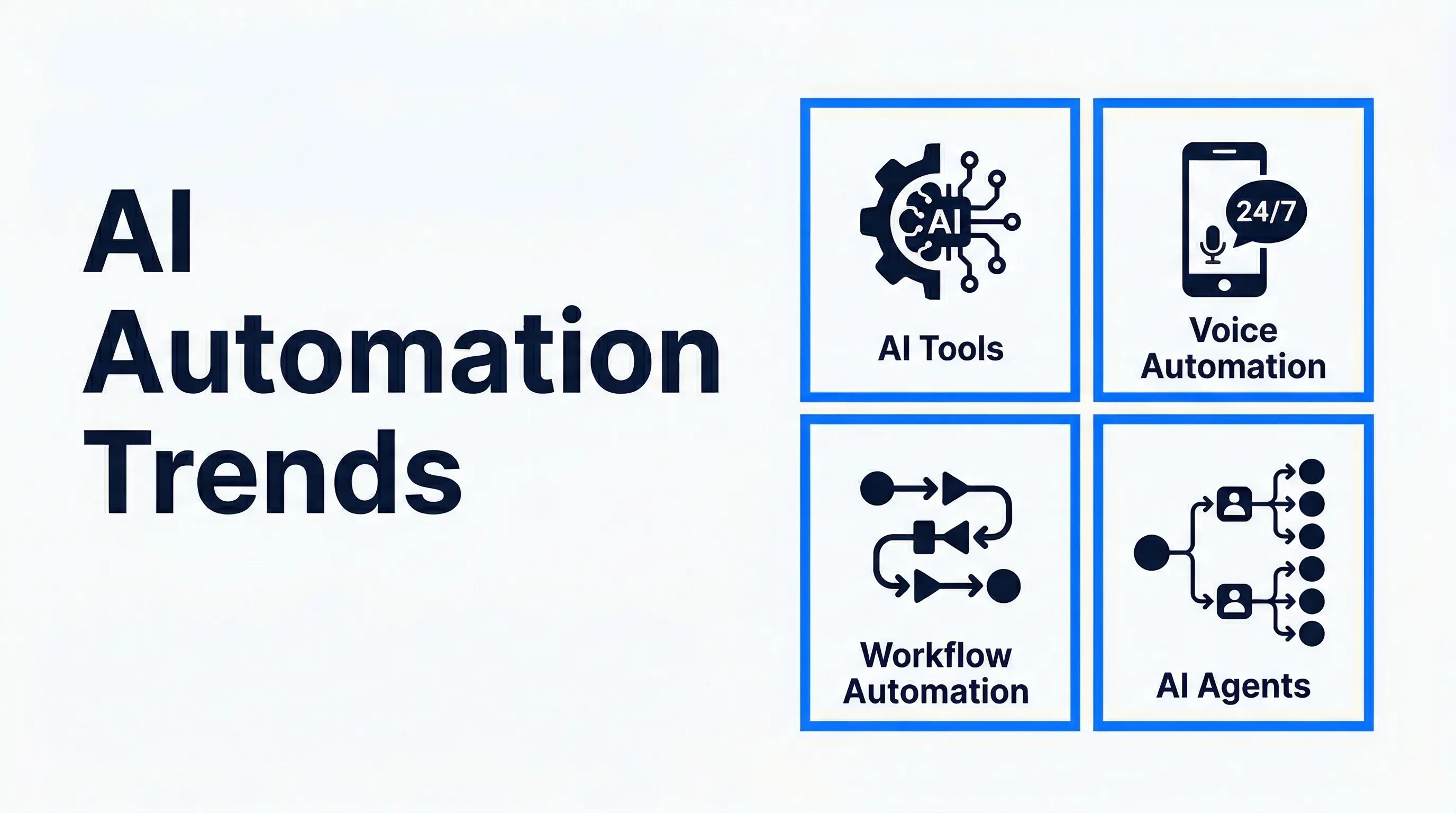
Quick Answer: The four AI automation trends reshaping small business operations in 2026 are accessible AI tools for day-to-day processes, voice automation that handles calls 24/7 without staff, workflow automation that eliminates manual admin, and AI agents that complete multi-step tasks end-to-end without human input. All four are available today and run inside the tools your business already uses.
The AI tools available to small businesses today would have required an enterprise budget three years ago. That gap has closed, and the businesses that recognise it now are recovering hours that were previously considered unavoidable overhead.
McKinsey Global Institute’s research found that generative AI could automate work equivalent to trillions of dollars in annual labour globally. What used to filter down to large enterprises first is now available to businesses with five employees and a laptop.
The four trends below are shaping what’s possible for small businesses right now.
The AI Automation Trends Reshaping Small Business Operations
A few years ago, implementing AI automation meant hiring a developer, buying an enterprise platform, and waiting months for results. That model is gone. The current generation of AI tools is built for deployment in weeks, runs inside the software your team already uses, and doesn’t require anyone on your staff to understand how it works under the hood.
The shift isn’t just about cost. It’s about accessibility. A small law firm, a five-person recruitment agency, or a solo accountant can now run the same quality of automated lead response, CRM management, and document processing that enterprise businesses use. The four trends below are where that capability is most concentrated.
The Growth of AI Tools Built for Business Operations
The most significant change in recent years is the move from developer-grade automation tools to operator-accessible ones. Platforms that previously required months of technical setup can now be configured in days by someone with no coding background, provided the system is designed correctly first.
More importantly, the tools have become purpose-built for specific business outcomes: automated email responses that understand context and intent, CRM updates that trigger from calendar events, document extraction that pulls structured data from unstructured inputs. These aren’t generic automation features. They’re direct replacements for specific tasks your team currently handles manually.
Deloitte’s Tech Trends research identifies small business AI adoption as one of the fastest-growing segments in enterprise technology, driven by tools that deliver measurable ROI within weeks rather than quarters.
An accounting firm that was spending 12 hours a week extracting invoice data from client documents can now run that extraction automatically. The data arrives in the right spreadsheet, in the right format, without anyone touching it. The 12 hours go back to billable work.
Voice Automation: Your Business Answers 24/7 Without Hiring
Missed calls are lost business. Most small businesses know this, and most of them can’t do anything about it. You can’t staff phone coverage around the clock when your team is already stretched across every other operational task during the day.
AI voice agents solve this directly. They answer calls within two rings, ask qualifying questions, assess intent, book appointments, and route complex enquiries to the right person. They run whether your office is open or not, and they handle volume that would overwhelm a human receptionist.
For industries where inbound calls are a primary lead channel, the impact is immediate. A local service business that misses a significant portion of calls during busy periods can capture every one of them with a voice agent in place. The agent qualifies the lead before anyone on your team invests time in a conversation.
Automiq AI builds and deploys AI voice agents inside the tools you already use for scheduling and CRM management. A lead that calls, gets qualified, and books an appointment never touches a manual step in your process.
Workflow Automation Is Replacing the Admin Layer
The category of work that eats the most time in most small businesses isn’t complicated. It’s repetitive: updating CRM records after calls, sending follow-up emails after meetings, generating proposals from client data, routing leads to the right team member.
Each of these tasks takes five to fifteen minutes individually. Across a week, across a five-person team, they add up to a substantial block of time that produces no client value. Workflow automation eliminates this category entirely.
A recruitment agency automating candidate follow-up, interview scheduling, and CRM record updates after each stage of the hiring process can eliminate several hours of coordinator work per day. The coordinator still exists. They spend their time on the parts of recruitment that require human judgment, not the parts that require copying information from one system to another.
See how Automiq AI designs and deploys workflow automations inside your existing tools, with no new platforms to learn and a fixed one-time fee. Review automation pricing and packages to see what fits your business size.
AI Agents Are Taking Over Multi-Step Business Tasks
Workflow automation handles linear tasks: if this happens, do that. AI agents handle something more complex: receive an input, evaluate it, make a decision, take an action, check the result, and continue through a multi-step process without human input at any stage.
This distinction matters because most high-value business tasks have more than one decision point. Lead qualification isn’t just routing. It involves checking whether the lead already exists in the CRM, scoring the lead against your criteria, deciding which team member should follow up, drafting a personalised response based on the lead’s specific request, and notifying the right person.
Gartner’s automation research identifies AI agents as among the fastest-growing categories of enterprise AI investment, with adoption accelerating rapidly among small and mid-sized businesses as the technology becomes more accessible.
An AI lead qualification agent can receive a website form submission, check the CRM for duplicates, score the lead against custom criteria, send a personalised response within five minutes (vs. the industry average of 24 hours), update the CRM record, and notify the relevant team member. All of that happens without a single manual step. The agent runs the same sequence for the first lead of the day and the fortieth.
How Small Businesses Should Respond to These Trends
The opportunity is clear. The practical question is where to start. Most businesses that try to act on all four trends at once end up implementing none of them properly.
Start with one. Then build from there.
- Identify the process that eats the most time per week. Not the most interesting one. The one your team complains about most.
- Map that process end-to-end before touching any tool. Document the trigger, the steps, the data that moves, and where it ends. This is the step most businesses skip, and it’s the reason most automations fail.
- Get it built by someone who has done it before. DIY automation platforms exist and they work well in the right hands. But if your team doesn’t have the time or expertise to design, build, test, and maintain the system, the fastest path to working automation is having an expert build it for you.
The businesses that are ahead on these trends aren’t the ones with the biggest budgets. They’re the ones that picked one process, automated it correctly, and expanded from there.
Frequently Asked Questions
What are the most important AI automation trends for small businesses in 2026?
The four trends with the most direct impact are accessible AI tools for operations, voice automation for 24/7 call handling, workflow automation replacing manual admin, and AI agents completing multi-step tasks without human input. Each one is available today to businesses with a CRM, email account, and calendar.
How much does it cost to implement AI automation for a small business?
Costs vary by scope. A single automated workflow typically runs from a few hundred to a few thousand dollars as a one-time build. Done-for-you services like Automiq AI offer fixed-fee packages with no ongoing agency retainer.
Do I need to change my existing tools to use AI automation?
No. The most effective automations run inside the tools you already use: your CRM, email client, calendar, and document storage. Adding new platforms is usually a sign the automation wasn’t designed around your actual workflow.
How quickly can I see results from AI automation?
A well-built automation delivers results from day one. Lead response time drops to under five minutes. CRM updates happen automatically after every call. The compounding effect builds over weeks as the automation handles volume that would otherwise stack up across your team manually.
Are AI agents only for large businesses?
No. A small service business can deploy an AI agent to qualify leads, update the CRM, and send a personalised response within minutes of a form submission, without any developer involvement if the system is built and deployed correctly.
What is the difference between workflow automation and AI agents?
Workflow automation handles linear, rule-based tasks: if this happens, do that. AI agents handle more complex conditional sequences: receive input, evaluate it, make a decision, take an action, check the result, and continue. Both are valuable. Agents are better suited for tasks with multiple decision points.
The Businesses That Act Now Build the Largest Lead
The four ai automation trends above aren’t predictions. They’re live capabilities available to any small business that chooses to implement them. The difference between the businesses recovering 30+ hours a week in admin and the ones still handling everything manually is not technology access. It’s the decision to start.
The fastest path from where you are now to working automation isn’t researching every platform on the market. It’s identifying one process, designing it correctly, and building it with someone who has done it before.
Book a free discovery call with Automiq AI and find out which of these trends applies directly to your business right now, with a custom automation blueprint built around the tools you already use.